Continuous surface mining isn’t a new method. Vermeer has produced surface miners for a quarter century.
But it remains misunderstood.
For over a century, drill and blast has been the default method for extracting rock and minerals even though it’s inconsistent, time consuming and risky — but it’s familiar.
That familiarity has created myths that keep operations from exploring the advantages that continuous surface mining offers.
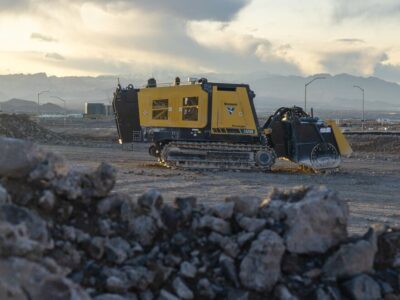
Enter the Vermeer SM55 surface miner, a compact surface miner designed to challenge the status quo. It’s built for versatility, precision and transportability, offering a compelling case for operations looking to reduce risk, improve efficiency and be a better neighbor.
Whether you’re in civil engineering, quarrying or mining, understanding the real advantages of continuous surface mining starts with clearing up the misconceptions.
Let’s start busting myths about surface mining.
Myth No. 1: Surface miners can’t cut hard rock
This is one of the most persistent misconceptions — and one of the easiest to disprove.
The SM55 is engineered to cut rock up to 16,000 psi (110.3 MPa), which includes materials like limestone, gypsum and iron ore. While it’s not designed to replace larger continuous surface miners, it is capable of handling a range of applications including serious work.
“The first reaction usually is (operators) just don’t believe surface miners can cut hard rocks,” said Mike Selover, corporate accounts manager for Specialty Excavation at Vermeer. “A lot of times we have to do a demo to prove it to them … Once they see for themselves and we’re able to put production on the ground based on what we said we would, then a lot of light bulbs go off.”
Surface mining allows quarries and mines to produce higher grade materials through a process known as selective mining. This allows operations to target specific areas of high-grade ore or aggregate within their geology.
“With blasting, if there is unwanted seams within the ore or aggregate body, this will cause product dilution,” added Caleb Oswald, applications engineer for Specialty Excavation at Vermeer. “With continuous surface mining, we can design GPS plans to chase specific high-grade seams, selective load the product and eliminate product dilution.”
Myth No. 2: Surface mining is only for small jobs
Another misconception.
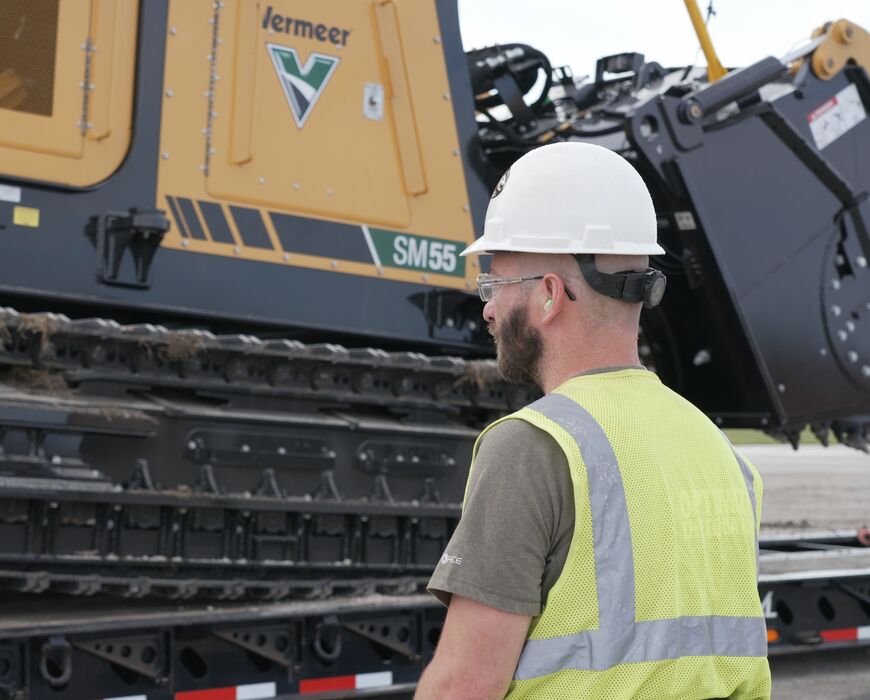
While the SM55 is compact and transportable, that doesn’t mean it’s limited to small-scale work. Its size is a strategic advantage — especially for operations with multiple jobsites, tight transport restrictions or civil engineering needs.
“One current customer has two T1255 surface miners … but they also have a couple quarries within 15 miles (24.1 km) and they’d rather have a smaller machine they can take around,” Selover said. “Whether you have a larger surface miner or not, you may consider having an SM55 because of its portability.”
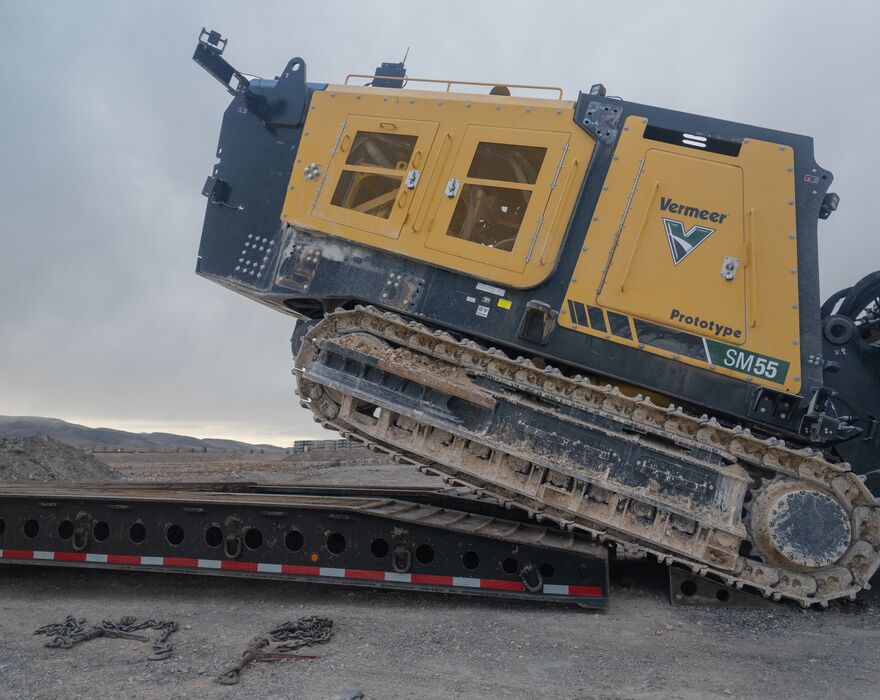
The SM55 weighs about 120,000 lb (54,431.08 kg) and is designed for single-load transport using a 10-axle tractor/trailer combo. Its drive-on/drive-off capability eliminates the need for cranes, rigging or specialized technicians — reducing downtime, permitting requirements and getting you to work faster.
“You could put a heavier machine on a trailer and drag it around,” said Mike Deitrich, applications engineer for specialty excavation at Vermeer. “But this machine is specifically sized to transport easier allowing customers to move down road and across bridges easier and with less permitting.”
It’s not about being small — it’s about being right-sized for the job.
Myth No. 3: Surface mining is more expensive than drill and blast
Not when you look at the whole operational costs of each method.
Surface mining often appears more expensive at first glance — but that’s because many cost comparisons overlook the full lifecycle of drill and blast. When you factor in labor, fuel and equipment for the drill-and-blast steps plus permitting and downtime, continuous surface mining can be equal or lower in cost per ton.
A study published in the Indonesian Mining Journal found that while continuous surface miner operating costs were slightly higher per ton in some cases, they eliminated the need for secondary fragmentation and reduced handling — resulting in comparable or better overall economics.
“Drilling and blasting — no matter how you count it — is at least eight, nine steps,” Selover said. “Every one of those steps has a different piece of equipment and a diesel engine and several different operators … If you’re honest with yourself, oftentimes continuous surface mining is the same cost or slightly lower.”
The SM55 also features the Tec® Plus computer-aided control system, which helps operators adjust controls to improve efficiency and uptime. Operators can access diagnostics and performance data through VermeerOne™, a centralized platform for machine manuals, telematics and maintenance tracking.
Myth No. 4: There are lots of safety risks with surface mining
Surface mining offers safety advantages over drill and blast — especially in urban-adjacent or environmentally sensitive areas. It eliminates the need for explosives, and the SM55 allows operators to work remotely from the machine.
According to MSHA Safety Services, surface mining offers safer working conditions than underground or blast-based methods, with fewer confined space risks and better dust control through dust suppression and remote operation.
“Who wants to store explosives? Who wants to take the responsibility of locking them up?” said Selover. “They often subcontract the explosives … as opposed to owning a continuous surface miner and having one operator where they can use their own labor, forego the risk, forego the safety hazard of blasting.”
The SM55’s operator station allows operators to manage the machine from the comfort of their truck, improving safety near highwalls and slopes. Optional onboard dust suppression systems are available to help reduce airborne silica exposure.
“You don’t have an operator bouncing around in an on-board cab,” Oswald said. “It’s going to be more ergonomically friendly to the operator, less fatigue throughout the day.”
Myth No. 5: Surface miners can’t scale across diverse jobsites
Just the opposite, in fact.
Scalability is one of surface mining’s strongest suits. From small quarries to massive multi-site operations, surface miners like the SM55 can be deployed flexibly and efficiently.
“The machine is going to be popular throughout the world in a variety of applications because of its size and its efficiency,” Selover said.
According to Mining Technology, the number of surface mining machines — dozers, hydraulic excavators, motor graders, rope shovels, trucks and wheel loaders — is projected to grow from 155,976 in 2024 to 170,982 by 2030, driven by demand for scalable, cost-effective solutions.
The SM55’s ability to move between sites with minimal permitting and setup makes it ideal for operations looking to maximize utilization across multiple locations.
How Vermeer supports mining operators beyond the sale
Vermeer backs the SM55 and its other surface miners with a full suite of tools and services designed to help customers succeed.
That starts with the Vermeer rock lab, where customer rock samples are tested at no cost to the customer using state-of-the-art equipment to validate rock properties and optimize cutting expectations. It continues with the Vermeer solutions calculator, which helps operators model cost per ton, tons per hour and machine utilization based on real data.
And it’s all supported by a global Vermeer dealer network and factory team that understands the demands of mining and civil construction operations.
“We ask to be partners in their business,” Selover said. “Ask for a rock sample, use our own resources to create a rock test report, and then give them … all the pre-feasibility information, the cost of ownership, cost per ton, tons per hour and tooth consumption with confidence in math, science and decades of data.”
Contact your local Vermeer dealer to learn more about how the SM55 can support your operations.
Airborne dust may reduce operator visibility and can cause bodily injury or damage to the persons or equipment exposed to it. Before using Vermeer equipment, operators should assess environmental conditions to determine whether the production of airborne dust is likely to occur and take all appropriate measures to reduce dust production and protect exposed persons and equipment. Vermeer equipment should always be operated in accordance with the operator’s manual.
Vermeer Corporation reserves the right to make changes in engineering, design and specifications; add improvements; or discontinue manufacturing at any time without notice or obligation.
Equipment shown is for illustrative purposes only and may display optional accessories or components specific to their global region.
Please contact your local Vermeer dealer for more information on machine specifications.
Vermeer, the Vermeer logo, VermeerOne and Equipped to Do More are trademarks of Vermeer Manufacturing Company in the U.S. and/or other countries.
© 2025 Vermeer Corporation. All Rights Reserved.