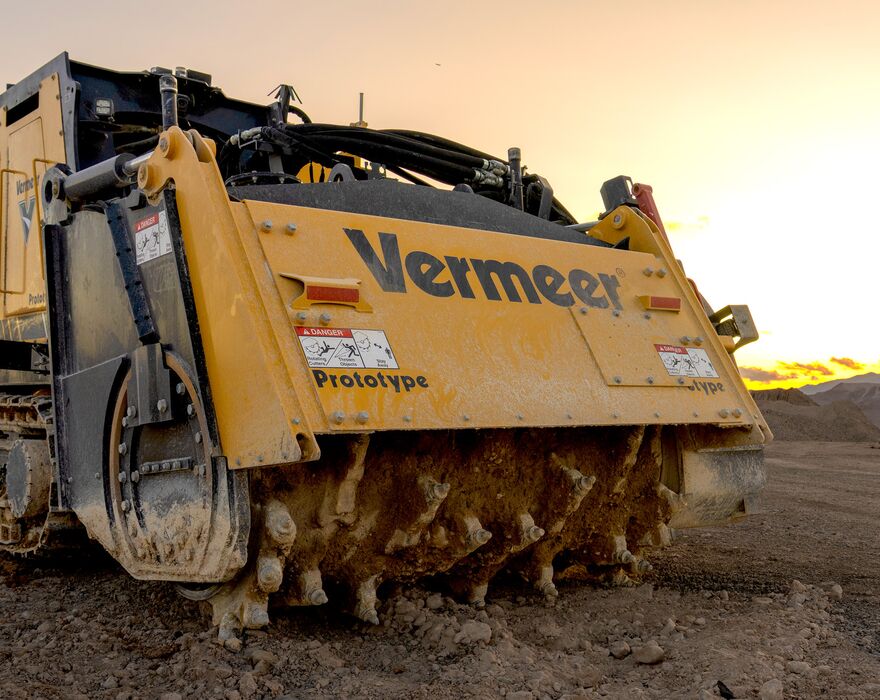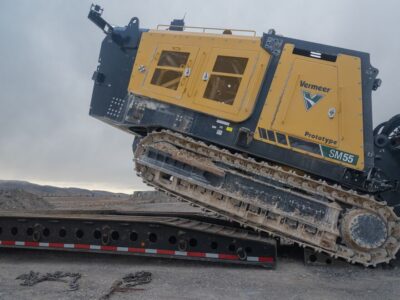
For surface mining operations that move between sites, transportability can have a major impact on schedule, mobilization planning and overall flexibility.
According to the International Journal of Mining Science, mobilization can affect the schedule, the cost per ton and whether a surface miner makes sense across one site or several.
Vermeer made that challenge much easier to solve with the SM55 surface miner.
Built for transportability, the SM55 uses single-load hauling and drive-on, drive-off loading to help reduce downtime between quarry sites, mines and civil site prep jobs.
Here are seven transport-friendly design choices on the SM55 and why they matter for quarry operators and site prep contractors.
1. Single-load surface miner transport for multi-site operations
The SM55 is designed to move as one unit rather than a machine that must be split into multiple loads.
“This machine is 120,000 pounds (54,431.08 kg),” said Mike Selover, corporate accounts manager for Specialty Excavation at Vermeer. “It goes on one trailer behind one semi, a 10-axle trailer.”
Why it matters: A single-load move can help reduce coordination, cut downtime and make multi-site utilization more realistic when a quarry group is juggling several locations.
2. Drive-on, drive-off surface miner hauling to reduce setup time
The SM55 uses a drive-on, drive-off transport approach with common industry equipment, helping simplify mobilization while eliminating the need for a crane.
For machines dedicated to long-term, high-production work at a single site, transport may be less frequent. But for crews moving between locations, a simpler mobilization process can make a meaningful difference.
Why it matters: Cutting crane dependency can help shorten the time between arrival and production, especially when crews are moving between quarry sites or rotating through civil site prep work.
3. Surface miner transport dimensions designed for predictable planning
The SM55 has transport dimensions of 350 in (889 cm) long and 136 in (345.4 cm) wide, so crews have a clear idea of the machine’s size when planning a move between sites.
Why it matters: Knowing the machine’s transport size can make trailer selection and route planning easier, helping reduce the chance of delays when a move is already on the calendar. For full transport details, download the SM55 spec sheet.
4. Surface miner transportability that helps reduce permitting friction
Because it is designed for single-load transport, the SM55 can help simplify move planning and permitting for operations that relocate equipment between sites.
“This machine is sized and weighted in a way that helps support permitting and allows crews to navigate roads and bridges more effectively,” said Mike Deitrich, applications engineer for specialty excavation at Vermeer.
Why it matters: A more manageable transport profile can help reduce permitting complexity and support smoother routing, especially when bridges and road restrictions are part of the move.
5. Surface miner transport without crane and rigging dependencies
For crews moving equipment between sites, the move involves more than transportation alone. If a machine must be separated for hauling, reassembly becomes part of the process before production can begin again.
The SM55 is designed to eliminate the need for crane-assisted assembly and disassembly during transport and setup.
“When you’re splitting in half, you’ve got two loads and then you have to have a crane when you get there to put it together,” Selover explained. “Then if you’re going to take it someplace else, you have to have a crane to disassemble it and then put it back together again.”
By removing crane and rigging needs from the move, the SM55 can help simplify coordination and reduce the time and money tied up in mobilization.
Why it matters: For operations that relocate equipment between sites, reducing setup dependencies can help lower schedule risk and make moves easier to plan.
6. Surface miner transportability that supports demos and first-time adoption
Surface mining often requires proof on a customer’s rock, which means demos are part of the sales process. Selover said the stakes are clear when the purchase is a capital investment.
That is where the Vermeer Rock Lab comes in. Since 2006, the lab has used state-of-the-art equipment and proven processes to test rock samples from mines and jobsites around the world, including limestone.
Samples are tested for key properties like unconfined compressive strength (UCS) and abrasivity, then summarized in a report that can be entered into a solutions calculator to help estimate production ranges and cost of operation based on jobsite-specific factors. This approach supports more informed conversations early, before a demo and as part of due diligence for a major investment.
Why it matters: A transport-friendly machine lowers the friction of education, demos and trial work because it is easier to move, easier to set up and easier to repeat across multiple prospects or sites.
7. Transport-friendly surface mining that complements high-production machines
Transport-friendly does not mean limited capability. It means a different kind of flexibility for operations that need to move between sites.
Selover positioned the SM55 as a complement to larger, higher-production surface miners. For producers running large machines on long-term quarry or mine work, the SM55 can be a practical addition when there is also a need to cover smaller nearby deposits, satellite pits, selective limestone work, maintenance projects or civil site prep jobs that call for easier mobilization.
Why it matters: The SM55 can help extend a fleet’s reach across smaller or more mobile applications, while larger machines remain the right fit for long-term, high-production work at a dedicated site.
Why surface miner transportability changes the business case for quarry crews
Transport is not an afterthought. It changes utilization, cost per ton and the kinds of projects a crew can pursue. The SM55 transport approach is built around single-load hauling, drive-on, drive-off loading and dimensions that support planning across sites.
- More time cutting, less time waiting: Single-load transport and drive-on, drive-off loading shorten nonproductive time tied to teardown and reassembly.
- Lower move-related costs: Fewer loads and fewer support resources can reduce stacked mobilization costs that follow multi-piece transport.
- More flexibility across sites: Weight and transport dimensions help support multi-site utilization when route, permitting or bridge limits shape the move.
Contact your local Vermeer dealer to learn more about how the SM55 can support your continuous surfacing mining operations.
Airborne dust may reduce operator visibility and can cause bodily injury or damage to the persons or equipment exposed to it. Before using Vermeer equipment, operators should assess environmental conditions to determine whether the production of airborne dust is likely to occur and take all appropriate measures to reduce dust production and protect exposed persons and equipment. Vermeer equipment should always be operated in accordance with the operator’s manual.
Vermeer Corporation reserves the right to make changes in engineering, design and specifications; add improvements; or discontinue manufacturing at any time without notice or obligation.
Equipment shown is for illustrative purposes only and may display optional accessories or components specific to their global region.
Please contact your local Vermeer dealer for more information on machine specifications.
Vermeer, the Vermeer logo, VermeerOne and Equipped to Do More are trademarks of Vermeer Manufacturing Company in the U.S. and/or other countries.
© 2026 Vermeer Corporation. All Rights Reserved.