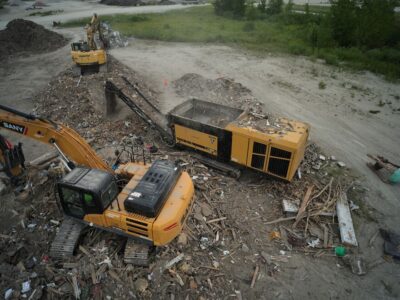
When disaster strikes, contractors mobilize fast and work through multiple phases of recovery under chaotic, high-stakes conditions. Rapid response, efficient processing and close coordination across crews and agencies all contribute to helping communities recover more quickly. The right storm debris cleanup equipment — from emergency land-clearing machines to the grinders and chippers that process mountains of wood waste — can mean the difference between a community recovering in days or weeks.
- Does your business have what you need to get roadways open and powerlines cleared so utility workers and emergency responders can get back in?
- Can your crew shift gears for the longer haul, hauling debris to staging areas and processing stockpiles for weeks or months?
- And when it’s time to prep for reconstruction, do you have the machines to remove stumps and get the site ready?
Throughout every phase of disaster recovery, Vermeer and our nationwide network of dealers and partners make equipment available when contractors need it most. Not just during the initial response, but across the full arc of the cleanup effort. Learn which tools are right for each type of job, real-world examples of this equipment put to the test and best practices to ensure your fleet is prepared for the next storm season.
What types of equipment are used in storm debris cleanup?
The right tools can make all the difference in disaster recovery operations. Some of the flood cleanup heavy equipment and tree debris removal equipment contractors tap when disaster strikes:
- Mini loaders and compact articulated loaders are indispensable in the early hours and days after a storm to move debris away from structures, feed material into chippers and navigate tight spaces in residential areas. They keep production flowing at every stage of a storm cleanup and mulching operation.
- Brush chippers handle the branches, limbs and smaller-diameter wood generated in huge volumes after storms. They’re the go-to for brush clearing after a storm in residential and commercial areas, chipping material directly onsite or processing curbside debris for transport.
- Horizontal grinders can take over when the volume of organic waste is too massive for chippers alone. (Think hurricane debris spread across an entire county). These high-throughput machines process large logs, brush and mixed wood waste into chips or mulch at scale. Track-mounted models allow operators to move quickly from pile to pile and reduce cycle times.
- Tub grinders are valuable after high-wind events that topple trees at the roots, leaving large, irregular root balls that are difficult to process. The wide-mouth tub design accommodates oversized material without additional cutting or handling.
- Whole tree chippers are essential for large-scale land-clearing operations after a storm because they can process trunk, limbs and all without the need for prior limbing or bucking. They vastly accelerate emergency and disaster recovery land-clearing work.
- Low speed shredders are purpose-built for storm cleanup jobs involving a mix of materials like construction debris, household products and green waste. Their high torque can process almost anything — from building materials like drywall, wood, pallets and plastics to utility infrastructure like telephone poles. Their efficient output also reduces space required in trucks and landfills.
- Stump cutters allow contractors to eliminate what’s left below the surface after fallen trees are removed, clearing the way for reconstruction and site restoration.
Vermeer storm cleanup equipment in action: Real disaster recovery stories
For decades, Vermeer equipment has been on the ground in disaster recovery efforts in the United States, the Caribbean and beyond. From a record-breaking Midwest derecho to Category 4 hurricane cleanup in Florida and Grenada to catastrophic flooding in Asheville, North Carolina, we’ve seen firsthand how these machines help enable a faster recovery.
In July 2018, an EF3 tornado tore through the Vermeer manufacturing campus in Pella, Iowa. Our teams put Vermeer equipment to work immediately and resumed regular operations within weeks. That experience shaped much of how we build and support our machines today.
Here’s how Vermeer has impacted real disaster recovery operations over the years, the machines that did the work and the difference Vermeer equipment made in helping rebuild communities faster.
October 2018: Hurricane Michael devastates Florida
Hurricane Michael made landfall as a Category 4 storm in October 2018, devastating communities across the Florida Panhandle and into Georgia. In Jackson County, Florida, alone, the organic waste generated was staggering. Ceres Environmental Services Inc., the country’s largest storm debris management contractors, managed the hurricane cleanup.
Crews first performed “cut and push” operations to clear roadways for emergency vehicles, then turned to large-scale grinding operations at a massive staging site where organic material had been hauled for processing. Nine Vermeer grinders combined to reduce 120 ac (48.6 ha) of material down to just 5 ac (2 ha). The output was repurposed as biofuel, landscaping material and organic matter for farm fields.
Vermeer equipment deployed:
- Two Vermeer HG6000 horizontal grinders for high-volume grinding of logs, brush and organic storm waste.
- Four Vermeer HG6800TX horizontal grinders on tracks were critical for repositioning across the sprawling 120-acre site, helping reduce cycle times and fuel costs.
- Two Vermeer HG8000 horizontal grinders added processing capacity for the highest-volume piles.
- One Vermeer TG7000 tub grinder for processing the large root balls generated when high winds topple trees at their roots.
Donny Bauer, project manager for Ceres Environmental, says heavy-duty processing equipment like the Vermeer line of grinders is essential. “With hurricanes, the volume of material is just too much to handle efficiently using just chippers in communities,” he said. “Chippers are still widely used, but the heavy, bulky stuff gets transported and ground up by horizontal and tub grinders.”
Bauer noted how much more quickly the work went with Vermeer’s HG6800TX horizontal grinders on tracks.
“One hundred and twenty acres is a lot of area, and it’s certainly more efficient to reposition grinders than having to carry material to those machines,” Bauer said. “With the four tracked HG6800TX grinders, in particular, we could quickly move them from one pile to the next, which helped reduce cycle times and save on fuel costs.”
August 2020: Record-breaking derecho slams Midwest
The derecho that struck the Corn Belt on Aug. 10, 2020, became the costliest thunderstorm disaster in US history, with more than $7.5 billion in damage according to the National Oceanic and Atmospheric Administration (NOAA). Millions of ac of crops, hundreds of homes and thousands of trees were damaged or destroyed across a wide swath of Iowa and surrounding states. The scale of wood debris processing after the storm was staggering. In Slater, Iowa, alone, the pile grew to roughly three blocks long, 50 ft to 70 ft (15.2 m to 21.3 m) wide and 30 ft (9.1 m) tall, within just a few days of the storm.
Vermeer equipment deployed:
- Vermeer mini skid steers moved debris away from homes and businesses to curbside staging areas. Compact enough for residential areas, versatile enough to keep production flowing.
- Vermeer brush chippers processed curbside wood waste into chips, with ground material turned into mulch for landscaping and public sale.
- Vermeer stump cutters removed tree stumps onsite after trees were cleared, restoring properties for reconstruction.
- Vermeer HG6800TX horizontal grinder was deployed immediately across municipalities, processing more than 10,000 yd³ (7,645.5 m³) of debris in Pleasant Hill, Iowa, in just a few days.
- Log loaders and wheel loaders hauled material to central grinding sites and fed the horizontal grinder via excavator with grapple attachment.
Mike Shores, field coordinator with Elder Corporation, a Pleasant Hill, Iowa-based land -clearing and organic wood waste grinding company on the derecho cleanup, noted how invaluable Vermeer’s equipment was to the cleanup, especially its Damage Defense system.
“As an operator, when you’re grabbing material out of a pile to process, you can only see the top of the debris,” Shores said. “But sometimes stuff has been thrown in there that’s not wood waste. In Muscatine, Iowa, for example, there was an engine crank in the middle of this pile, and we didn’t know it. That’s a pretty big chunk of steel. The Vermeer Damage Defense system caught it and kicked it out.”
May 2024: Tornado sweeps through Greenfield, Iowa
Concrete, wood, metal, vegetation and household items were strewn across Greenfield, Iowa, after a massive EF4 tornado struck the city in spring 2024. Residential neighborhoods and commercial structures faced significant damage, and recovery teams needed to move fast. Bulk material had to be hauled immediately to prevent waste piles from overwhelming the community, and crews worked overtime to process the complex mix of debris.
Vermeer equipment deployed:
- Skid steers, rubber track excavators and loaders were used to collect debris in the downtown area.
- Vermeer LS3600TX low speed shredders processed mixed construction debris quickly and efficiently.
EIS Holdings was among the contractors on the ground, deploying Vermeer low speed shredder equipment as the centerpiece of their debris reduction strategy. Jeremy Boka, vice president of business development at EIS Holdings, said efficiency’s the name of the game when it comes to a large-scale time and materials project.
“The Vermeer LS3600TX has been a huge asset to us,” Boka said. “By shredding with the LS3600TX, we achieve 40 to 50 percent better capacity and significantly reduce landfill airspace usage. That saves time and fuel on the road and extends the lifespan of the landfill by using space more efficiently.”
April and July 2024: Derecho and Hurricane Beryl test Texas landscapers
Texas faced back-to-back severe weather events in 2024 — a derecho in April followed by Hurricane Beryl later that summer — leaving landscaping contractors scrambling to clear debris across multiple markets while protecting the surfaces their clients depend on. For Clean Scapes Landscaping, a 100% employee-owned contractor serving Austin, Houston and beyond, rapid response meant deploying compact articulated loaders precise enough to work around buildings, on golf courses and in tight residential spaces without compounding the damage already done.
Vermeer equipment deployed:
- Vermeer ATX530 compact articulated loaders cleared blocked driveways and access roads in tight residential and commercial areas, helping protect turf and hardscaping throughout.
- Vermeer ATX720 compact articulated handled higher-capacity material movement across larger sites, feeding chipper trucks and managing debris where traditional equipment couldn’t.
Greg Fox, arbor director at Clean Scapes, said the ATX loaders were indispensable when speed and surface protection had to coexist.
“The ATX loaders were essential for rapid response,” he said. “The turf-friendly tires and superior maneuverability allowed us to complete projects that would have been impossible with traditional equipment. We could quickly clear blocked driveways and access roads while protecting the underlying surfaces. Having the right equipment let us assess and address urgent needs across affected areas much more efficiently.”
What makes Vermeer equipment effective for disaster recovery?
Speed, durability and versatility are critical for effective disaster recovery. Here’s what sets Vermeer equipment apart when the pressure is on for contractors to clean up storm debris fast:
- Nationwide dealer network: When crews run 24 hours a day 7 days a week, access to job-ready machines, expert specialists and replacement parts in recovery zones is critical. Vermeer’s extensive parts and service network across the US means contractors can source essential tools and support even in the middle of a major recovery operation. Vermeer dealers and partners also work to ensure customers have what they need throughout the full cleanup effort, not just during the initial response.
- Oversized material handling: High-wind events leave behind oversized root balls and irregular materials that are difficult to process. The Vermeer TG7000 tub grinder is built specifically for storm cleanup involving odd-shaped debris, helping keep production moving when other machines would slow down or stop.
- Mixed debris efficiency: Not all storm debris is wood. The Vermeer LS3600TX efficiently processes mixed construction waste — wood, metal, building materials and more — through high-torque, slow-speed shredding. Help gain capacity, minimize hauling costs and reduce timelines on large-scale jobs like tornado debris removal.
- Built to move with the work: Track-mounted grinders and loaders are invaluable for debris cleanup across large, uneven staging. The Vermeer HG6800TX and other track-mounted horizontal grinders allow operators to reposition quickly across large staging sites without requiring additional equipment to move them.
- Smart, rugged damage prevention: Metal contaminants like bolts, wire, utility covers and engine parts end up in organic piles frequently and can cause serious damage to horizontal or tub grinders if hit at full speed. The Vermeer Damage Defense system automatically detects certain metal contaminants entering the mill and initiates a controlled shutdown before serious damage occurs, helping avoid costly repairs and production interruptions.
- A shorter learning curve: Vermeer horizontal grinders share universal controls from model to model. In a disaster recovery deployment where crews may be operating multiple machines or unfamiliar equipment, consistent controls help reduce the learning curve and help newer operators get productive quickly.
Storm preparedness for contractors: Prep your equipment before the season
Equipment readiness before storm season is an ongoing discipline rather than a one-time checklist. Contractors who keep their fleets ready can mobilize quickly, take on work immediately, and keep production running once they’re onsite.
Here are the a few key preparation steps for your storm-season equipment fleet:
- Service all machines at recommended intervals before peak storm season. This includes filters, fluids like hydraulic oil, belts and any components flagged during the previous season.
- Inspect and sharpen brush chipper knives. Dull knives slow production and make the machine work harder. Replace in matched sets to maintain drum balance. You’ll also want to have a spare knife kit on hand.
- Check stump cutter teeth. If tips are rounded, flip or replace them before the season starts. Having extra teeth and pockets in inventory will be helpful if you encounter concrete or rock in debris piles.
- Replace worn belts on belt-driven machines (such as PTO-style chippers and stump cutters) per the manufacturer’s schedule. The drum drive belt on the Vermeer BC1000XL brush chipper, for example, should be replaced every 500 hours.
- Stock critical wear parts. Use your slow season to build up inventory before demand spikes. For brush chippers, keep at minimum a main drive belt and knife kit. For larger fleets, also stock anvils, bed knives and shear bars.
- Verify and calibrate Damage Defense system settings on your horizontal grinders. Before heading into storm debris, which can be full of hidden metal, confirm the Damage Defense system is active and properly calibrated for the job.
- Inspect track systems on track-mounted grinders. Track tension, roller condition and undercarriage wear should all be verified before deploying to uneven, debris-covered terrain.
- Confirm towing equipment and transport compliance. Review DOT guidelines, ensure trailer connections are secure and perform pre-trip inspections on every brush chipper and machine being trailered to a jobsite.
- Consider enrolling in Vermeer Confidence Plus® asset protection program. This program covers the first four service intervals with dealer-certified technicians, helping machines maintain peak condition before and during storm season.
Contractor storm preparedness checklist
Here’s a starter checklist to help make sure your equipment is ready for the call come storm season. Adapt it to your specific fleet and the types of cleanup operations most common in your region and refer to your machine’s operator’s and maintenance manuals for safety messages and further instructions:
Brush chippers:
- Knives inspected, sharpened or replaced
- Spare knife kit stocked
- Main drive belt inspected; spare on hand
- Drum and infeed system clear and functional
- Feed-sensing controls tested
- Transport and trailering hardware verified
Stump cutters
- Cutter wheel teeth inspected; extra teeth and pockets stocked
- Cutter wheel rotates freely with no unusual resistance
- Belt tension set to proper spec
- All guards in place
Horizontal grinders and tub grinders
- Damage Defense system active and sensitivity confirmed
- Cutting components inspected
- Hydraulic system checked for leaks
- Controls and emergency stop tested
- Track system inspected for tension and wear (if applicable)
Low speed shredders
- Cutting components inspected
- Hydraulic system checked
- Infeed hopper and discharge system cleared
- Control systems verified
Mini loaders and ATX loaders
- Engine, fuel and air intake inspected
- Hydraulic lines checked for leaks
- All attachment connection points verified
- Tracks or tires inspected for wear
General fleet readiness
- Service records up to date for all machines
- Local Vermeer dealer contact information on hand
- Spare parts inventory reviewed and restocked
- Vermeer Confidence Plus program enrollment verified (if applicable)
- Crew PPE inspected and available (chainsaw chaps, eye/ear protection, high-visibility vests and helmets)
The right storm debris cleanup equipment for the hardest jobs
Disaster relief work is one of the most demanding environments any mulch and waste contractor will ever encounter. The volume of material is enormous, the pressure to restore communities is immediate and the debris itself can punish equipment that isn’t up to the task.
Vermeer equipment has proven its value in some of the most challenging storm debris cleanup operations. Brush chippers, horizontal grinders, tub grinders, low -speed shredders, mini skid steers and stump cutters each play a specific role in the recovery timeline. Together, they form a complete toolkit for contractors looking to win more disaster recovery work.
Talk to your local Vermeer dealer today about disaster recovery equipment for contractors, building out the right fleet and ensuring your equipment is ready to respond when your community needs you most.
This article contains third-party observations, advice or experiences that do not necessarily reflect the opinions of Vermeer Corporation, its affiliates or its dealers. Testimonials and/or endorsements by customers in specific circumstances may not be representative of normal circumstances experienced by all customers.
Vermeer Corporation reserves the right to make changes in engineering, design and specifications; add improvements; or discontinue manufacturing at any time without notice or obligation.
Equipment shown is for illustrative purposes only and may display optional accessories or components specific to their global region.
Please contact your local Vermeer dealer for more information on machine specifications.
Vermeer, the Vermeer logo, Equipped to Do More and Vermeer Confidence Plus are trademarks of Vermeer Manufacturing Company in the U.S. and/or other countries.
© 2026 Vermeer Corporation. All Rights Reserved.