Part 2 – Coordinated crews and strict service schedules add efficiency to managing equipment fleets
Having the right tree care equipment and using it appropriately are two major components of effectively managing an equipment fleet, but people and parts also play an important role.
The role of staff
According to Jonathan McNeil, director of operations for Arborguard, based in Atlanta, Georgia, managing tree-care equipment fleets most effectively involves proper staffing allocation and expertise. “Every member of our staff has acquired the knowledge and experience that qualify them to perform more than 90 percent of the jobs we complete. Most crew members are assigned to the same task using the same equipment every day; an approach that also contributes to optimizing equipment fleet management and utilization.”
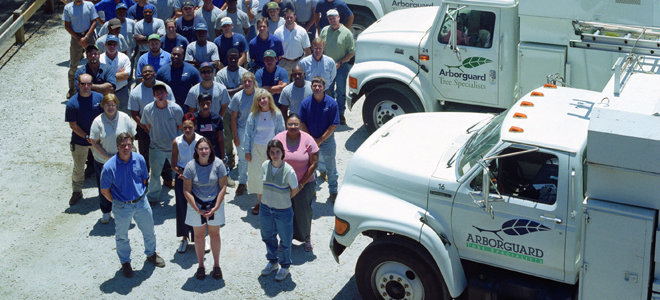
Founded in 1981, Arborguard has become one of the leading tree-care companies in the Southeast U.S. The company provides a variety of both traditional and innovative services for a wide range of commercial and residential tree-care applications including trimming, pruning, tree removal, emergency storm services, tree preservation programs and tree risk assessment. With more than 40 employees and six full-time crews, Arborguard is well-equipped to handle the many challenging conditions often encountered by professional tree-care service providers.
“We’ve found that assigning the same crew members to the same tasks and functions results in enhancing productivity,” McNeil says. “I group the guys with specific skill levels, abilities, likes/dislikes if you will, and match them to certain functions. Then I match equipment with specific tasks to maximize efficiency.”
“Matching the same guys with the same equipment performing the same functions has worked very well for us,” McNeil says. “For instance, the guys that work primarily in commercial tree-care applications are assigned smaller trucks and brush chippers, since these models are more efficient in processing material derived from commercial applications.”
Extending brush chipper life
Adherence to a diligent service and maintenance schedule is another component of helping maximize equipment fleet management and operational efficiency. To that end, McNeil is adamant about completing daily and periodic maintenance work as recommended by equipment manufacturers.
“We have a maintenance agreement that ensures we follow a strict service rotation schedule. Reminders are automatically triggered, letting us know when various service functions should be performed,” McNeil says. “As a result, we’re experiencing longer productive equipment lifespans, as well as more efficient and productive wood chipper operation. All these factors help contribute to our overall company bottom-line.”