Josh Vrieze has spent years helping tree care professionals find the right equipment for the job. Lately, he’s been hearing a new kind of question: “Do you have anything electric?”
“It’s not just our customers,” said Vrieze, senior product manager at Vermeer, “it’s their customers as well that are asking for these types of operations.”
That growing interest is part of a broader shift in the tree care industry. While gas and diesel machines remain the backbone of most operations, electric tree care equipment is carving out a role in specific environments — especially where noise, emissions or regulations are a concern.
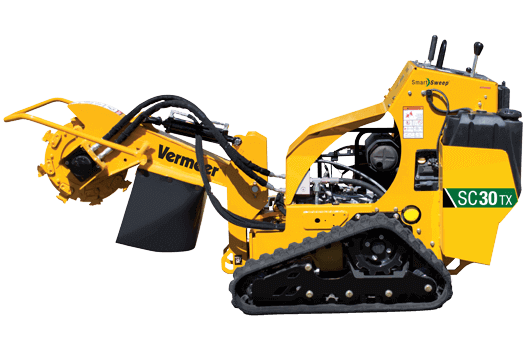
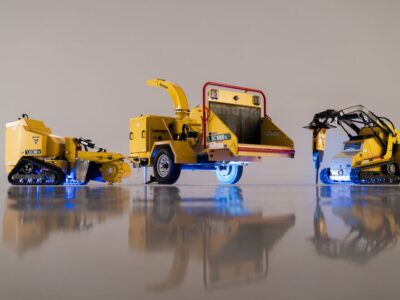
Vermeer is responding with a measured rollout of four new electric models: the SC30TX-E stump cutter, S450-E mini skid steer, BC1000XL-E brush chipper and BC200-E (available in Europe).
These machines aren’t meant to replace the internal combustion engine lineup of Vermeer tree care equipment. Instead, they offer new options for contractors and rental businesses navigating evolving customer expectations and jobsite requirements.
“We’re at the early stages here,” Vrieze said. “And that’s where I think Vermeer wants to be prepared — so that as this market continues to grow, we’re ready.”
Why is electric tree care equipment gaining attention?
The shift toward electrification is being driven by a mix of regulatory pressure, customer demand and evolving jobsite realities. In California, Assembly Bill 1346 curbs the sale of new gas-powered small off-road engines, starting with the 2024 model year. According to the California Air Resources Board, small gasoline engines used in lawn and garden equipment pollute at a higher rate than cars. They hope zero-emission equipment helps the state meet its air quality goals.
“We’re hearing more and more people talk about the emissions and what that does to the environment,” Vrieze said. “And I think we’re also seeing more and more chargers available … and having it just be more generally accepted in the market.”
Where does electric equipment make the most sense?
Electric machines are ideal for tree care contractors who:
- Operate in regulated or urban environments
- Work early mornings or late evenings
- Need to reduce noise or emissions
- Want to align with customer expectations
In fact, some landscaping professionals are already seeing a return on their electric investments. As highlighted by the National Association of Landscape Professionals, companies offering electric landscaping services are attracting clientele who value quieter, cleaner operations, and some can command higher rates and secure more projects because of their low-emission offerings.
Vrieze pointed to the Vermeer electric stump grinder as an example: “It’s crazy quiet. It almost sounds like a box fan running when you turn it on.
“I would not have a problem going next to someone’s house at seven o’clock in the morning and starting that up and start grinding stumps. I don’t think it would wake someone up.”
The electric mini skid steer offers similar benefits.
“I’m not going to have a neighbor mad at me. I’m not going to have some of the ordinances … stop me from operating that mini skid steer,” Vrieze said of the S450-E. “The hours of operation are going to be great.”
What are the challenges of electric tree care equipment?
Electric equipment isn’t without limitations. Range anxiety remains a concern — especially for contractors who don’t return to a shop each night.
“We’ve talked to customers who park their machines at a (box store parking lot),” Vrieze said.
Price is another factor. “It is higher priced, no doubt about it,” he said.
“But if you’re charging back at your shop … your fuel cost is going to drop drastically.”
That cost advantage is backed by data. According to the U.S. Environmental Protection Agency, electric vehicles — and by extension, electric equipment — are significantly more energy efficient than gasoline-powered alternatives. EVs convert about 87–91% of the energy from the battery into movement, compared to just 16–25% for gasoline engines.
Electric tree care equipment may offer productivity gains in specific applications as well.
“The torque out of an electric motor is instant,” Vrieze said. “There’s just a lot more torque and a lot more power available at the wheel on an electric stump cutter.”
Is the tree care industry ready for electric equipment?
The tree care industry is still in the early stages of electrification — but momentum is building.
According to Core Market Research, the global stump cutter grinder market was valued at about $2.3 billion in 2023, with a projected compound annual growth rate of 5.2% through 2035.
Zero-emission equipment isn’t replacing gas and diesel. It’s expanding what’s possible.
For contractors and rental businesses looking to stay ahead of regulations, meet customer expectations and explore new business opportunities, it’s a shift worth watching.
If you are interested in electric tree care equipment, contact your local Vermeer dealer.
Vermeer Corporation reserves the right to make changes in engineering, design and specifications; add improvements; or discontinue manufacturing at any time without notice or obligation.
Equipment shown is for illustrative purposes only and may display optional accessories or components specific to their global region.
Please contact your local Vermeer dealer for more information on machine specifications.
Vermeer, the Vermeer logo and Equipped to Do More are trademarks of Vermeer Manufacturing Company in the U.S. and/or other countries.
© 2025 Vermeer Corporation. All Rights Reserved.