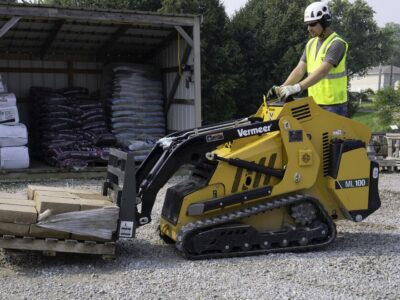
When you are buying a mini loader, the first question is not which model has the biggest number on the spec sheet. It is which machine fits the work you do every day.
Our Vermeer ML lineup includes four models — the ML80 mini loader, ML100 mini loader, ML130 mini loader and ML150 mini loader — and together they give you options for everything from residential landscape and rental work to demanding tree care, truck loading, utility and heavier-duty jobs.
If you are sorting through mini loader questions or looking for a mini loader FAQ, start with the job.
- Are you working in fenced backyards?
- Loading trucks?
- Running attachments all day?
- Moving material on bigger landscape jobs?
- Taking on tree care, utility or hardscape work that asks more from the machine?
This guide is built to help you narrow the lineup around those real decisions.
Quick answers about Vermeer mini loaders
- Need a compact machine for residential landscape settings, light tree work or rental applications? Consider the ML80 mini loader. Its compact footprint and radial lift path help you work in tight jobsites without giving up lift capacity, hydraulics or operator comfort.
- Need more power for demanding landscape, rental or urban tree care work? Step up to the ML100 mini loader. With added torque for running attachments, it gives crews more muscle for tougher daily work.
- Need vertical lift for larger jobs and truck loading? Move to the ML130 mini loader. It is built for bigger landscape projects, demanding tree care work and loading tasks that call for more reach and more capacity.
- Need maximum capability for hardscape, utility, tree care, trenching, hauling, digging or grading? Look at the ML150 mini loader. It sits at the top of the lineup for the jobs that ask the most from the machine.
- Need one machine that can take on more than one kind of task? The Vermeer mini loader lineup works with a full lineup of approved, compatible attachments, with uses that range from trenching and grading to hauling and digging.
What should you look for when buying a mini loader?
The fastest way to narrow the lineup is to focus on the things that change how the machine works on your jobs — access, lift path, attachment demand, operator workflow and workload. Get those answered, and the right model usually becomes clear.
- How tight is access? If you work behind fences or through narrow gates, start there. The narrow track option on the ML80 mini loader and ML100 mini loader can fit through 36 in (91.4 cm) gates. The ML130 mini loader and ML150 mini loader clear 42 in (106.7 cm) gates.
- Will you spend time loading trucks or working at height? If so, lift path matters. The ML130 mini loader and ML150 mini loader use vertical lift, which helps with loading and dumping at height and makes both models a strong fit for truck-loading work. If more of your day is spent on ground-level tasks in tighter spaces, radial lift can be the better fit — which is why the ML80 mini loader and ML100 mini loader make sense for compact jobsites and work like digging, grading and pushing material.
- How hard will you lean on attachments? If one machine needs to trench, grade, haul and dig, attachment capability should be high on the list. Vermeer mini loaders work with a full lineup of approved, compatible attachments, and the ML100 mini loader, ML130 mini loader and ML150 mini loader all bring turbocharged power to help crews get more out of attachment-driven work.
- How often will operators be on and off the machine? When crews climb on and off all day, comfort and ease of use matter. Vermeer mini loaders are built with easy on-and-off capability and a cushioned chariot-style platform designed for comfort.
- How much machine does the work really require? If your jobs regularly lean into utility, hardscape or heavier material handling, it makes sense to start further up the lineup. The ML150 mini loader is built for demanding work such as trenching, hauling, digging and grading.
Which Vermeer mini loader fits your work?
ML80 mini loader
Choose the ML80 mini loader when access is one of the first problems to solve. It is built for residential landscape settings, light tree work and rental applications, with a 780-lb (353.8-kg) rated operating capacity, a 25-hp (18.6-kW) diesel engine, a compact footprint and a radial lift path for tight jobsites.
The ML80 mini loader is also a smart fit when you want a strong lift-capacity-to-weight balance in a compact machine. Its overall size is similar to the ML100 mini loader, but it carries less weight, which can make sense when access, maneuverability and efficient material handling matter most.
Best fit if you need:
- A compact machine for smaller jobsites
- A model for residential landscape work, light tree work or rental use
- A machine that puts access first while still bringing efficient lift capacity and hydraulic performance
ML100 mini loader
Choose the ML100 mini loader when you need a machine that can do a little bit of everything well. It steps up to a 950-lb (430.9-kg) rated operating capacity, adds a turbocharged 25-hp (18.6-kW) diesel engine and brings a strong mix of size, lift-capacity-to-weight ratio and performance. That makes it a smart fit for demanding rental, landscape and urban tree care work where crews want more power and versatility without moving into the largest machines in the lineup.
Best fit if you need:
- More power than an entry model without jumping into the largest machines in the lineup
- A radial-lift-path machine for demanding landscape or urban tree care work
- A versatile machine that balances compact size, turbocharged performance and efficient lift capacity
ML130 mini loader
Choose the ML130 mini loader when you need to load higher and do more in a day. It brings a 40-hp (29.8-kW) turbocharged diesel engine, a 1,270-lb (576.1-kg) rated operating capacity and a vertical lift path built for larger landscape projects, demanding tree care work and truck loading.
Best fit if you need:
- A step into larger jobs and heavier daily output
- Vertical lift for truck loading and loading-at-height work
- More machine for demanding landscape and tree care applications
ML150 mini loader
Choose the ML150 mini loader when the work asks the most from the machine. It sits at the top of the Vermeer ML lineup with a 1,530-lb (694-kg) rated operating capacity and a 40-hp (29.8-kW) turbocharged diesel engine. It is built for hardscape, utility, tree care and heavy-duty work such as trenching, hauling, digging and grading, with vertical lift for loading and dumping at height.
Best fit if you need:
- The most capacity in the ML lineup
- Vertical lift for loading and dumping at height
- A machine for hardscape, utility, tree care and heavier-duty material handling
Mini loader questions answered
What is the best Vermeer mini loader for landscaping?
The best mini loader for landscaping is the one that matches the scale and rhythm of your work.
For residential landscape settings, smaller properties and jobs where access is tight, the ML80 mini loader is often the right starting point. As work becomes more demanding — more material to move, more attachment use, longer days — the ML100 mini loader brings added power to help keep productivity up.
Larger landscape projects that involve loading trucks, moving heavier material or covering more ground tend to push into the ML130 mini loader, while heavier‑duty landscape and hardscape work often leads to the ML150 mini loader, where maximum lift capacity and overall capability matter more day to day.
In practice, most landscape buyers land on the right machine by balancing where they work with how hard the machine works during a typical day. Access, attachment demand and material handling usually decide it faster than a spec sheet ever will.
Which Vermeer mini loader is best for truck loading?
If truck loading is a regular part of the job, lift path matters.
The ML130 mini loader and ML150 mini loader use vertical lift, which helps when loading at height. The ML130 and ML150 mini loaders are a common fit for crews that need consistent truck‑loading capability without stepping into a much larger machine.
What attachments can Vermeer mini loaders run?
Vermeer mini loaders are built to do more than one job, often on the same day. With a wide range of attachments for tree care, landscaping work and snow removal, one machine can handle digging, grading, hauling and cleanup — and stay productive when the seasons change.
Common attachment uses include:
- Buckets and forks for moving material, pallets and debris
- Trenchers and augers for irrigation, utility and landscape installs
- Grapples for brush, logs and cleanup work
- Grading and leveling tools for site prep and finish work
- Snow removal attachments, such as blades, that keep the machine working through winter
That versatility is what can turn a mini loader into a four‑season investment instead of a single‑purpose purchase. Rather than parking the machine when the work changes, you can adapt it to the job in front of you.
Because attachment needs vary by model, application and hydraulic demand, the best next step is to talk with your local Vermeer dealer about the tools you plan to run most often and how they match up with each mini loader.
How important is operator comfort on a mini loader?
More than most buyers expect — especially once the machine is in daily rotation.
Mini loaders are often used in stop‑and‑go work. Operators climb on and off the machine repeatedly, move between tasks and spend long hours standing on the platform. Over a full day, comfort, stability and ease of entry can affect focus and productivity just as much as lift capacity or horsepower.
That is why details like a cushioned, chariot‑style platform, clear sightlines and easy on‑and‑off access matter. They help operators stay steady underfoot, move confidently around the jobsite and stay comfortable through long stretches of work. When crews are more comfortable, they work more consistently — and that shows up in the pace and quality of the job.
Comfort is not a “nice to have.” On a machine that is used all day, every day, it directly shapes how the mini loader feels to run and how willing operators are to stay productive behind the controls.
How do mini loaders actually get used day to day on landscaping and tree care jobs?
On most landscaping and tree care crews, a mini loader is not a single‑task machine. It is a daily workhorse that moves between tasks, attachments and jobsites throughout the day.
In landscaping, mini loaders are commonly used to move soil, mulch, sod and hardscape materials, trench for irrigation or lighting, prep grade and handle cleanup. Their compact size allows crews to work behind fences, between buildings and in finished yards where larger equipment cannot go without causing damage.
In tree care, mini loaders are often used for material handling and cleanup — moving brush, logs and debris, staging material for chipping and reducing the amount of manual labor required onsite. The ability to switch attachments quickly helps crews adapt as the job changes from removal to cleanup.
Across both segments, mini loaders tend to see frequent on‑and‑off operation, repeated attachment changes and steady use over long days. That combination of access, versatility and productivity is why many crews rely on a mini loader to keep work moving rather than treating it as a specialty tool.
How do I buy a mini loader from Vermeer?
Buying the right mini loader starts with understanding your work — and ends with a short, job‑focused conversation.
- First, focus on the work you do most often, not the outliers. Think about where you work, how tight access can be, how often you change attachments and how hard the machine works during a typical day.
- Next, narrow the lineup by comparing models side by side. Look at access, lift path, attachment capability and workload to identify the machines that realistically fit your operation.
- From there, the most valuable step is talking with your local Vermeer dealer. A dealer conversation helps turn general guidance into a clear recommendation — walking through real job conditions, attachment compatibility and daily demands to make sure the machine you choose fits the way you work.
When you’re ready to take the next step, find your local Vermeer dealer to continue the conversation and move from research to the right machine with confidence.
Vermeer Corporation reserves the right to make changes in engineering, design and specifications; add improvements; or discontinue manufacturing at any time without notice or obligation.
Equipment shown is for illustrative purposes only and may display optional accessories or components specific to their global region.
Mini loader attachments available from Vermeer dealers may be manufactured by Vermeer Corporation or other attachment manufacturers. Please contact your local Vermeer dealer for more information on machine specifications and attachments.
Vermeer, the Vermeer logo and Equipped to Do More are trademarks of Vermeer Manufacturing Company in the U.S. and/or other countries.
© 2026 Vermeer Corporation. All Rights Reserved.
