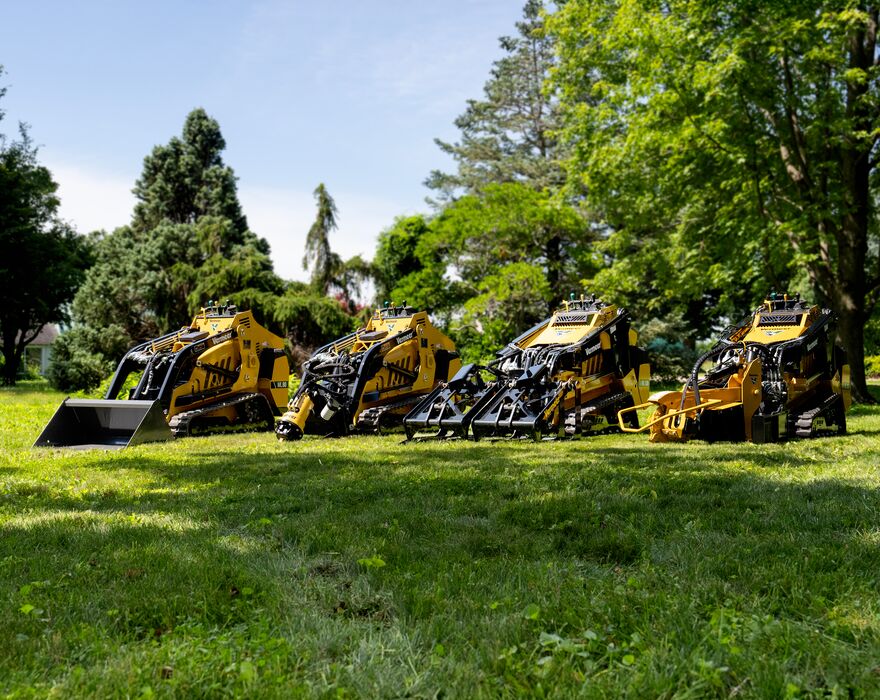
Ask a landscape contractor what it costs to put a crew of two on a job and the answer comes back fast. Ask what it costs when that crew of two produces like a crew of three and the math gets more interesting. That second number is the one Adam Bellas has been working with for 20 years, and for most of them the answer has involved a mini loader.
Bellas Landscaping LLC started in Bloomington, Illinois, in 2003 with a mower, a truck and a trailer. Adam Bellas and his brother took on mowing and small projects, moved into mulching and pruning, then into full design-build work. For the first three years, the heavy lifting was done with shovels and wheelbarrows. Today the company runs design-build landscape projects across Central Illinois and keeps six Vermeer mini loaders on the job.
How a mini loader becomes a third crew member
Bellas Landscaping introduced its first Vermeer mini skid steer on the jobsite in 2006. The Vermeer rep covering the territory brought it out, back when this product line was new to Vermeer. The reason it landed was access: residential design-build work happens on tight lots and zero lot lines, and a full-sized machine could not get into the spaces where the work actually was.
The fleet grew from there, and so did the way the company thought about it. A machine goes out with a crew the same as a person does.
“We often run six or more crews, and all six machines regularly go out at the same time,” Bellas said. “On every one of them the Vermeer mini loader is the extra crew member.”
He means that literally. When Bellas Landscaping bids a patio, nobody adds a line for machine time. The mini loaders are carried as overhead, the same as the trucks and trailers, because a machine is going on that job either way.
What makes that work is the gap between what a machine costs and what it stands in for. A crew member earns an hourly rate, accrues vacation and draws a retirement contribution. A mini loader takes fuel and an oil change. That gap is what lets the company add crews without adding overhead at the same rate.
The math Adam Bellas runs on it is simple. Ten minutes saved on one task, multiplied across every crew working that day, is more than an hour of labor back. On a big job where shaving off half a day moves the margin, that adds up fast.
Sizing a mini loader for gates and tight lots
Access is what started all of this, and it still decides which machine goes on the job.
The Vermeer ML100 mini loader runs 36 in (91.4 cm) wide on narrow tracks and 40 in (101.6 cm) on wide tracks, with a 950-lb (430.9-kg) rated operating capacity and a 24.7-hp (18.4-kW) diesel engine. Five of the six machines at Bellas Landscaping are ML100 units, which tells you what the work looks like: fenced backyards, gates and properties where the only way in is one bucket at a time.
The sixth is a Vermeer ML150 mini loader, 42 in (106.7 cm) wide with a 1,530-lb (694-kg) rated operating capacity and a 40-hp (29.8-kW) diesel engine, for the jobs where lift capacity matters more than the last 6 in (15.2 cm) of clearance.
Cristian Rojas, a hardscape foreman who has been at Bellas Landscaping about eight years, runs a crew of two and puts the machine through most of a typical hardscape day.
“We can squeeze through a five-foot fence with a bucket of rock. Without that, everything in the backyard moves by wheelbarrow,” Rojas said.
Attachments do the rest. Buckets move aggregate that used to move by wheelbarrow. Forks set pallets of pavers next to the patio instead of staging them at the curb. Bellas described the old sequence plainly: a paver got handled four times before it reached its final position. Now the pallet lands where the crew is working.
Tracked machines also matter for what they leave behind. Crews can work back and forth across a lawn with far less surface impact than a full-sized machine, which often means regrading and reseeding a yard.
What a mini loader does for crew retention
Most contractors buy a machine to work faster. Adam Bellas buys them to keep his people.
Landscape work is strenuous from April through Thanksgiving. Crews move trees weighing 400 lb to 500 lb (181.4 kg to 226.8 kg), set outcropping stone and handle pallets in the heat. The company has crew members who have stayed on hardscape work year after year, and Bellas ties that directly to what the machine takes off their bodies.
He is blunt about the alternative. Tell a crew they are unloading a truckload of trees by hand, he said, and they find another industry. He has seen the reverse too: people leaving other companies to come work at Bellas Landscaping because the equipment is there and it runs.
Keeping it running is its own discipline. A full-time mechanic has been with the company more than 15 years, working almost exclusively on Vermeer equipment, and the shop runs preventive maintenance every time a machine comes back: wash it, check for a leak, check for a loose bolt, catch it before it stops production in the field.
Why dealer support matters for landscape contractors
Bellas Landscaping buys from Vermeer Midwest, and Clint Kearfott has covered the Bloomington-Normal territory for much of the 20-year relationship.
“Reliability and uptime for a business is very crucial,” Kearfott said. “Labor is probably one of their biggest expenses, so they have got to be able to rely on that equipment to hold together and be there every day.”
For a company with a full-time mechanic, the dealer is a parts pipeline. For a two or three-person landscape company without one, Bellas points out, it is more: the machine has to run tomorrow morning, and somebody has to make that happen.
Growing a mini loader fleet alongside the crews
Bellas Landscaping adds a machine about every other year, and Adam Bellas has told his sales rep where he wants to end up: one on every crew, not just the main design-build crews. It is not really a purchasing plan. It is a rule he wants to be able to keep: no crew goes out without one.
The trade-up cycle is part of what makes that affordable. Machines get traded in rather than retired, and Bellas points to resale as a real line in the decision. He calls a mini loader an asset that holds its value, which is why the fleet count only ever moves in one direction.
Bellas puts it more plainly than that.
“I just really couldn’t see us on a jobsite without a Vermeer mini loader,” he said. “If we’re not taking one, the job better be planting a single shrub.”
Your crews are the business, and what they have to lift is what decides whether they are still with you in five years. Compare the Vermeer mini loader lineup, then talk with your local Vermeer dealer about which size fits the gates and the lift work your crews see most.
This article contains third-party observations, advice or experiences that do not necessarily reflect the opinions of Vermeer Corporation, its affiliates or its dealers. Testimonials and/or endorsements by contractors in specific circumstances may not be representative of normal circumstances experienced by all customers.
Vermeer Corporation reserves the right to make changes in engineering, design and specifications; add improvements; or discontinue manufacturing at any time without notice or obligation. Equipment shown is for illustrative purposes only and may display optional accessories or components specific to their global region. Mini loader attachments available from Vermeer dealers may be manufactured by Vermeer Corporation or other attachment manufacturers. Please contact your local Vermeer dealer for more information on machine specifications and attachments. Vermeer, the Vermeer logo and Equipped to Do More are trademarks of Vermeer Manufacturing Company in the U.S. and/or other countries.
© 2026 Vermeer Corporation. All Rights Reserved.