
For 2 Stone Industries, a fast-growing pipeline contractor in West Texas, tackling massive projects like a 44-mi (70.8-km) Kinetik pipeline means having a versatile and powerful equipment fleet.
Their key to conquering diverse terrains and meeting aggressive timelines? A strategic combination of high-production Vermeer trenchers and powerful Vermeer horizontal directional drills (HDDs). This dual-threat approach allows them to optimize every phase of the installation.
“We started in 2016 with a little utility drill,” Oscar Pena, one of the owners of 2 Stone, recalled. “The growth since then? I guess you give God the credit because I don’t know how we did it, to be honest.”
That growth has been built on a reputation for taking on tough jobs and getting them done efficiently, a feat made possible by smart equipment choices and experienced crews.
The 2 Stone game plan: Trenchers for the open stretches, HDDs for the crossings
On any given pipeline project, the 2 Stone team carefully evaluates the terrain and project requirements to deploy their equipment most effectively. The Kinetik project involved installing a 44-m (70.8-km), 30-in (76.2-cm) natural gas liquids pipeline stretching from Toyah to Kosa in West Texas. The pipeline needed to be mechanically complete and ready to flow in just three and a half months, an aggressive timeline that required careful planning and execution.

Making miles with Vermeer trenchers
For the approximately 36 mi (57.9 km) of open-cut installation on the Kinetik pipeline, 2 Stone relied on their fleet of Vermeer trenchers, including the T855III, T1055III and T1155III pipeline trenchers.
“We work around a lot of rock in all of West Texas,” Pena noted, emphasizing the need for equipment that can handle challenging geology.
The ability of these track trenchers to not only cut through tough ground but also to process the spoil into usable backfill is a significant advantage. Junior Marroquin, general superintendent with 2 Stone, explained, “That’s a great thing about those trenchers. When they hit rock, they produce fine material instead of chunks. We can lay this material on top of the pipe before backfilling.”
This on-site creation of suitable padding material, as detailed in resources about the trencher advantage in challenging conditions, saved 2 Stone considerable time and expense by helping to reduce the need to haul in fill.
“Ninety percent of the open cut was trenched,” confirmed Joseph Barrera, general superintendent with 2 Stone, underscoring the trenchers’ primary role in these sections.
Precision and power: Vermeer HDDs for complex bores
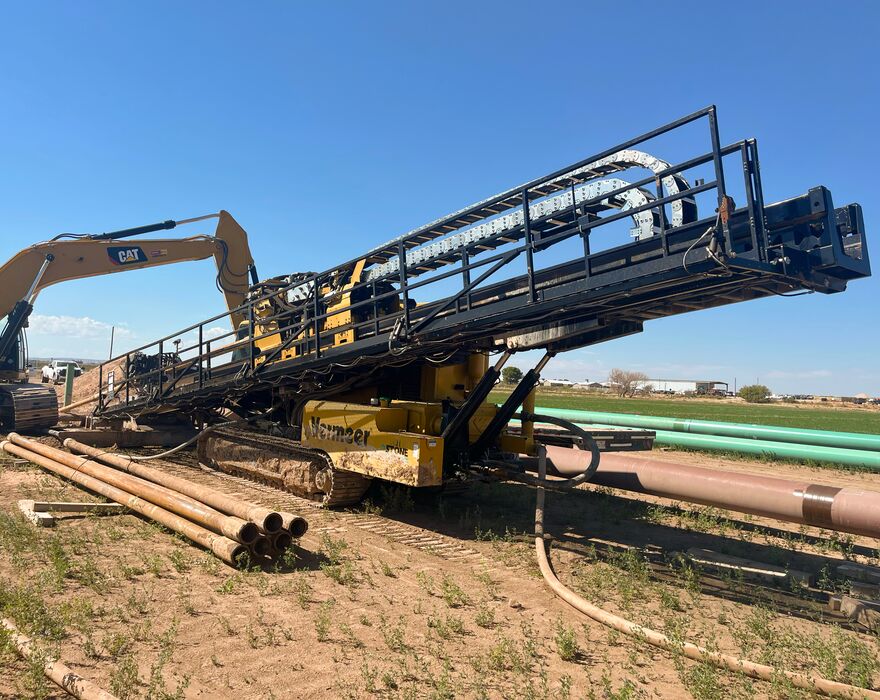
When obstacles or sensitive areas made open-cutting impractical, 2 Stone’s HDD crews took over. The Kinetik project involved around 36 such crossings. For these, they often employed a strategic pairing of their Vermeer D100x140 S3 HDDs and the more powerful D220x500 S3 HDDs.
Pena detailed their approach: “On that 30-in (76.2-cm) project, when we were in a lot of hard rock with the D100x140 S3 drills, the bigger reamers were struggling to turn. So, we used the D100x140 S3s to drill the pilots and ream out to a 24-in (61-cm) hole. Then the D220x500 S3 would come in, go back through the hole, ream it out to the 42-in (106.7-cm) diameter needed for the 30-in (76.2-cm) pipe, and then pull the pipe. That process really worked well for us.”
This adaptability is crucial when contractors must decide when to use trenchers vs. HDDs or even how to best sequence different HDD units.
One of the most demanding bores was an Interstate 20 and parallel railroad crossing. Barrera recounted the challenge: “That one was certainly challenging because of the railroad. You have to cross at a precise angle and maintain a straight, level path, not just under the railroad itself, but across their entire right-of-way also.”
The D220x500 S3’s power and precision were vital for successfully completing this 42-in (106.7 cm) reamed bore at a depth of around 20 ft to 25 ft (6.1 m to 7.6 m).
Why a combined approach works for 2 Stone Industries
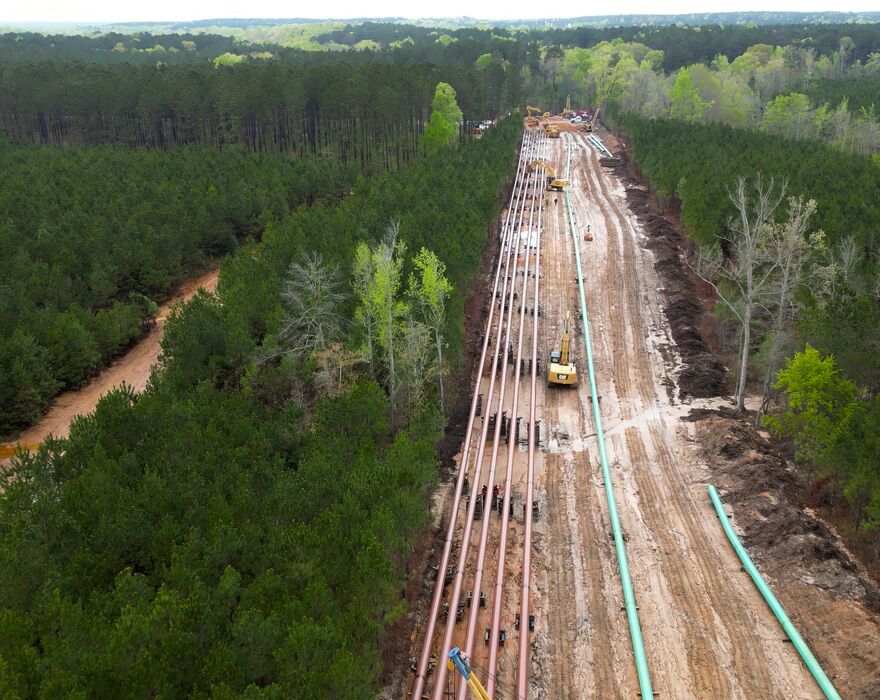
For 2 Stone Industries, the strategy of using both trenchers and HDDs is not just about having different tools; it is about optimizing the entire project. This combined fleet allowed them to complete the demanding 44 mi (70.8 km) Kinetik pipeline, from clearing to mechanical completion, in just three and a half months.
Peter Scharlau, a project manager with 2 Stone, spoke to the equipment choices: “Once we got with Vermeer, we just kind of stuck with it. We were satisfied with their products.”
This satisfaction extends to the versatility of their fleet. The ability to deploy trenchers for speed in open areas and HDDs for precision at crossings means they can adapt to almost any challenge the right-of-way presents. This aligns with the broader industry understanding of choosing the right installation method for underground utilities.
The common control systems across different Vermeer drill models also offer an advantage. Pena noted, “It makes a huge difference. Our operators jumped from the D100x140 S3s to the D220x500 S3s, and everything’s so similar. It’s a very easy transition.”
2 Stone’s formula for pipeline productivity
The success of 2 Stone Industries on projects like the Kinetik pipeline underscores the effectiveness of a well-planned, dual-method approach. By leveraging the strengths of their Vermeer trenchers for high-volume earthmoving and their Vermeer HDDs for intricate crossings, they have developed a formula for tackling even the most complex Texas pipeline projects with confidence and efficiency. Their experience serves as a valuable testimonial to the power of combining the right equipment strategies to meet modern pipeline demands.
To learn more about how Vermeer equipment can support your pipeline projects, explore the full range of pipeline solutions available or contact your local Vermeer dealer.
This article contains third-party observations, advice or experiences that do not necessarily reflect the opinions of Vermeer Corporation, its affiliates or its dealers. Testimonials and/or endorsements by contractors in specific circumstances may not be representative of normal circumstances experienced by all customers.
Vermeer Corporation and Vermeer MV Solutions, Inc. reserve the right to make changes in engineering, design and specifications; add improvements; or discontinue manufacturing at any time without notice or obligation. Equipment shown is for illustrative purposes only and may display optional accessories or components specific to their global region. Please contact your local Vermeer dealer for more information on machine specifications. Vermeer, the Vermeer logo and Ace are trademarks of Vermeer Manufacturing Company in the U.S. and/or other countries.
© 2025 Vermeer Corporation. All Rights Reserved.