Data centers – driven by rapid AI adoption and expanded cloud services – could use up to 12% of U.S. electricity by 2028, according to a December 2024 Department of Energy summary of a Lawrence Berkeley National Laboratory report.
What does this mean for your utility installation company? An unprecedented business opportunity.
Utility contractors are critical in supporting data center infrastructure, connecting reliable power and high-speed internet to support the AI surge.
Let’s take a look at how data center buildouts will depend on utility contractors.
What utility infrastructure do data centers need access to?
Like many building projects in the 21st century, there are three basic utility needs for data centers: energy, water and high-speed internet connectivity.
- Energy: Used to power the servers and networks needed to compute.
- Water: Used to cool servers to proper computing temperatures.
- High-speed internet connectivity: Used to deliver computed data and answers back to users at rapid rates.
All of these utilities need contractors for installation.
Data centers started in locations with easy access to this robust infrastructure. But their exponential demand means some centers must be built along with the utilities or utility connection.
What are the energy needs of data centers?
“Because of AI, the energy and tech sectors are now on a journey together,” according to the International Energy Association (IEA).
Energy and technology will continue to become even more intertwined as generative AI chat bots and tools are integrated to produce more efficiency both at work and at home.
A 2025 study from McKinsey & Company showed that 88% of participants surveyed reported regularly using AI in at least one business function – a 10% increase from the previous year’s survey.
Increased adoption of AI means increased energy consumption. The increase in energy comes from two main factors: more data centers operating and the increased computing power required.
To meet the space needs to compute AI, major data center construction initiatives have been announced by large technology companies.
One example announced in 2025 is the Stargate Project sponsored by OpenAI, SoftBank, Oracle and MGX. To develop a network across the United States, GlobalData reports that the project has a $500 billion AI data center infrastructure plan.
Building more data centers is not the only reason for the increased need for energy. Training AI models requires more computing power and energy from the servers within the centers.
According to a report from GlobalData, the processing units used to train AI uses “five to eight times more energy than conventional processors.”
To support this increased energy need, a recent study from McKinsey estimates a combined investment of $5.2 trillion from companies across the compute power value chain by 2030.
What energy sources are used to power AI?
Supporting the growth of AI requires major investments in energy infrastructure, power grid expansion and the utility installation work that comes with it.
“For data centers, reliability is the name of the game, and downtime is the No. 1 thing they want to avoid,” said Sid Avasthy, Vermeer marketing and brand insights analyst.
The leading energy sources for data centers are natural gas and renewables, according to the IEA, and each bring unique advantages.
Natural gas
- Provides reliable, around-the-clock electricity regardless of weather conditions.
- Helps data centers avoid costly downtime by delivering consistent power generation.
- Leverages an established pipeline network that already supplies energy across the country.
Renewable energy
- Helps organizations meet sustainability goals and reduce greenhouse gas emissions.
- Includes energy sources that continue to grow in popularity worldwide, such as solar and wind power.
- Supported by regulations and policy initiatives, including the European Union’s goal of reaching net-zero greenhouse gas emissions by 2050.
As AI adoption accelerates, investments in multiple energy sources, including natural gas and renewable energy infrastructure, are expected to grow. For utility contractors, that means more opportunities to help build the power networks and expand the power grid that keeps data centers running.
What are the internet and fiber needs for data centers?
The backbone of data centers is high-speed internet connectivity. That is how data travels from the center to the end user.
Mature, high-speed internet infrastructure grids are also hot spots for where data centers are being built in the United States and across the globe.
For example, GlobalData reports that the data centers in Frankfurt, Germany, are some of the most important in Europe due to it being the “world’s largest internet exchange point.”
To get AI answers from computing on data center servers to appearing on your device’s screen, it needs strong internet grid connections. And the faster users want answers, the faster information needs to travel between the data center and your screen.
The Fiber Broadband Association estimates that the United States must increase fiber route miles by nearly two times to meet the demands of data center growth.
Put simply, the more data centers built, the more the fiber network infrastructure is needed to support them.
Utility contractors are critical in expanding the grid through fiber installation.
How does data center construction impact your underground utility installation business?
The power, water and internet infrastructure needed to support data centers can all be installed underground with the right utility directional drilling equipment.
There are some utilities, namely power and internet, that can be installed above ground. Installation costs can be a differentiator when it comes to using power lines versus underground drilling.
But companies building data centers are looking at making the investment underground mainly for two reasons: the reliability of underground infrastructure and the pressure from communities living near the data centers.
Underground infrastructure reliability in extreme weather
The protection of the ground provides stability for utilities like power and fiber. This is particularly impactful in areas with a lot of diverse and dangerous weather events.
According to the U.S. Department of Energy Grid Deployment Office, “the key advantage of underground transmission and distribution lines is substantially reduced vulnerability to disruption from extreme weather.”
This can include events such as hurricanes, thunderstorms, snowstorms and wildfires, to name a few.
The report goes on to provide case studies of numerous weather events where underground utilities faced minimal impact compared to aerial utilities.
This reliability makes underground utility installations preferable to overhead systems in parts of the world regularly experiencing outages due to weather.
For long-distance power transmission and utility installation projects, contractors use Vermeer pipeline trenchers to install infrastructure underground, helping improve grid reliability for data centers and the communities that depend on the same power network.
Communities want minimized visual impact
Communities surrounding major data centers, like those in Loudoun County, Virginia, are also large proponents of underground infrastructure for data centers.
Loudoun County is known as “Data Center Alley” due to key fiber infrastructure, which has been in place since the 1990s, according to the Loudoun County government website.
But with even more data center projects on the horizon for the county, residents are speaking out against powerlines citing concern for property values and aesthetics to the community, as reported by the BBC.
“My local HOA is fighting the idea of putting power lines in the sky or in the air,” said Avasthy, who is also a resident of Prince William County, Virginia, where similar data center growth is on the way. “They’re saying it’s going to decrease our property value by 15% and nobody wants to look at them. They’re pushing these utility companies to put those lines in the ground.”
These concerns have grown into proposed bills, legislation and investments by governments in Virginia and across the country.
In a report from the Virginia Mercury, Loudoun County Supervisor Laura TeKrony talked about investing in underground installation for the parts of the electric line to “minimize and mitigate the impacts on residential communities that will be increasingly impacted by transmission lines to serve data centers.”
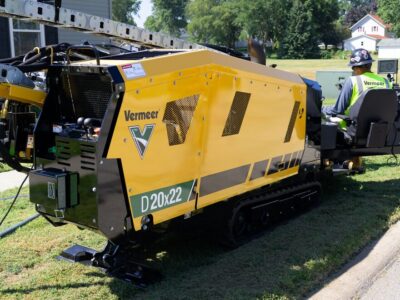
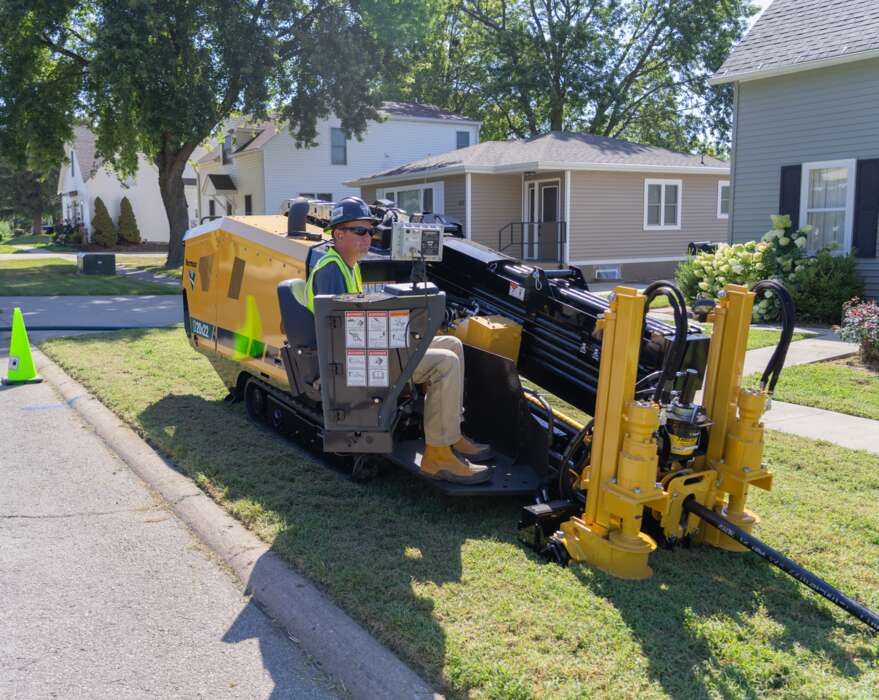
When installing new fiber and utility connections in developed areas, contractors rely on Vermeer utility horizontal directional drills to place infrastructure underground while minimizing disruption to roads, landscapes and the surrounding community.
Underground utility installation is a solution that can compromise the needs of the community and the data centers.
Is my utility installation equipment fleet ready to support the construction of data center infrastructure?
As AI continues to grow, access to it becomes more of a necessity. Supporting data center infrastructure is just another way utility contractors connect people around the world to the necessities of life.
Whether you use directional drills, trenchers or vacuum excavators, all of it will be needed to power AI in data centers across the world – and Vermeer has the equipment to help get the work done.
Needing to change or expand your fleet to meet this demand? Learn more about equipment used in utility installation.
This article contains third-party observations, advice or experiences that do not necessarily reflect the opinions of Vermeer Corporation, its affiliates or its dealers. Testimonials and/or endorsements by customers in specific circumstances may not be representative of normal circumstances experienced by all customers.
Vermeer Corporation reserves the right to make changes in engineering, design and specifications; add improvements; or discontinue manufacturing at any time without notice or obligation.
Equipment shown is for illustrative purposes only and may display optional accessories or components specific to their global region.
Please contact your local Vermeer dealer for more information on machine specifications.
Vermeer, the Vermeer logo and Equipped to Do More are trademarks of Vermeer Manufacturing Company in the U.S. and/or other countries.
© 2026 Vermeer Corporation. All Rights Reserved.