
Continuous surface mining and drill and blast don’t have to be an either-or decision. Many mining operations can benefit from using both methods on the same site, with each technique handling different aspects of the operation. Here are the most common questions about when and how to integrate continuous surface mining with existing drill and blast operations.
What are the main applications for continuous surface mining in drill and blast operations?
Continuous surface mining excels in several complementary roles at drill and blast sites. Mike Selover, Vermeer corporate accounts manager, explained: “We saw continuous surface mining filling critical gaps that drill and blast couldn’t address efficiently. Expanding a current mine’s annual tonnage without putting extra demand on the primary crusher by providing consistent particle size distribution (PSD) with few fines, mining under power lines or next to buried infrastructure, mining close to roads and highways, capable of mining 24/7 to smooth out production, precision extraction of high grade ore without product dilution, mine floor restoration, precise water management and roadway maintenance are areas where continuous surface mining really shines alongside traditional blasting operations.”
The primary applications include:
- Mine floor restoration: Creating a flat, engineered, exceptionally smooth floors after blasting operations
- Water management: Cutting sloped floors or precise drainage channels to direct water flow
- Roadway construction and maintenance: Building and maintaining haul roads, ramps and access routes
- Selective mining: Targeting specific material seams while avoiding product dilution
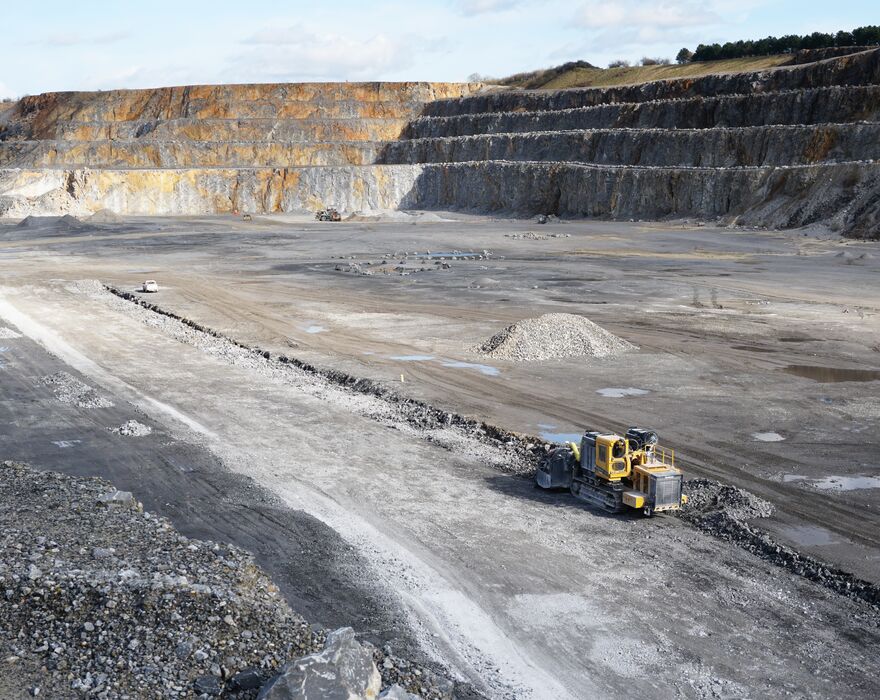
How does surface mining vs drill and blast compare for water management?
Water is one of the biggest challenges in quarry and mining operations. While producing production tonnage, continuous surface mining can create precise slopes for the pit floor, effectively solving the water drainage issues that drill and blast operations cannot achieve.
“With continuous surface mining, you could cut a sloped floor that directed all water to one corner of the pit where you had your pit sump,” noted Selover. “You can also create roads with the desired slope, crown, width and shoulder height, and because you are cutting into the ore body directly with less than .5 in (1.27 cm) of precision GPS guidance, there are no potholes or rough terrain to traverse, helping to extend the life of transmissions and tires on haul trucks.”
Can continuous surface mining reduce the load on existing crushing equipment?
Yes, this is a major advantage for brownfield expansions. When mines want to increase production but don’t want to invest in larger crushing equipment, continuous surface mining provides a solution.
“The crusher is often the biggest cost and highest maintenance item at a mine site,” explained Selover. “When you want to expand current operations, continuous surface mining makes sense because you put no additional demand on your primary crusher while getting increased production.”
The consistent 9-in (22.9 cm) minus material (with very few fines) that comes directly from a continuous surface miner often matches what would typically come out of a secondary crusher, allowing operations to often bypass the primary crusher altogether.
When do vibration restrictions make continuous surface mining necessary?
Many drill and blast operations face zones where blasting is prohibited due to proximity to sensitive infrastructure, urban encroachment, waterways and roads. Underground utilities like gas, sewer and water, telecommunications lines and nearby buildings create no-blast zones that limit traditional mining methods.
“Many surface mines find themselves surrounded by development as cities expand,” Selover said. “What used to be rural operations now have neighborhoods, schools or businesses nearby, making it nearly impossible to use explosives because of the vibration and dust concerns from the community.”
These community concerns translate into regulatory restrictions and operational limitations. Seismic monitoring requirements and liability concerns around potential damage to underground pipelines or electrical infrastructure make continuous surface mining the only viable option in these restricted areas. This allows operations to extract valuable material from zones that would otherwise remain off-limits to traditional blasting methods.
How does continuous surface mining improve safety compared to drill and blast?
Continuous surface mining eliminates several safety risks associated with drilling and blasting:
- No explosives handling: Removes the need to store, transport, detonate and handle dangerous materials
- No blast vibrations: Eliminates seismic effects that can damage nearby structures
- Precise material removal: Allows safe work near high walls and existing infrastructure
- Reduced dust: Generates significantly less airborne dust than blasting operations
Additionally, remote operation capabilities keep operators away from potentially dangerous work areas while maintaining full control of the cutting process.
What should operations consider when integrating surface mining vs drill and blast methods?
Several factors determine whether continuous surface mining makes sense as a complement to drill and blast:
- Rock hardness: Continuous surface mining works best in materials with around 16,000 PSI (110 MPa) compressive strength.
- Project scope: Projects requiring precise grading, minimal disruption or work in restricted areas are ideal applications for adding continuous surface mining to existing drill and blast operations.
- Location constraints: Operations near populated areas, sensitive infrastructure or environmental concerns may benefit from the quieter, vibration-free operation of continuous surface mining.
- Material quality requirements: When material purity or specific sizing is critical, continuous surface mining offers better control than blast fragmentation and can eliminate product dilution found in all drill and blast operations.
How does the investment compare to expanding drill and blast operations?
The economics depend heavily on the specific application. For infrastructure and maintenance work, continuous surface mining often provides better value than mobilizing full drill and blast crews for smaller projects.
“You had to look at the total cost of the drill and blast process, that’s eight or nine different steps with different equipment, operators and a lot of diesel,” Selover said. “For certain applications, one machine with one operator can be more cost-effective, especially when you factor in the ability to use your own labor instead of subcontracting.”
The key is matching the right tool to the specific job requirements rather than trying to force one method to handle all applications.
Ready to enhance your operation?
Contact your local Vermeer dealer to discuss your specific site requirements and learn how continuous surface mining can complement your existing drill and blast operations.
Vermeer Corporation reserves the right to make changes in engineering, design and specifications; add improvements; or discontinue manufacturing at any time without notice or obligation. Equipment shown is for illustrative purposes only and may display optional accessories or components specific to their global region. Please contact your local Vermeer dealer for more information on machine specifications. Vermeer and the Vermeer logo are trademarks of Vermeer Manufacturing Company in the U.S. and/or other countries.
© 2025 Vermeer Corporation. All Rights Reserved.