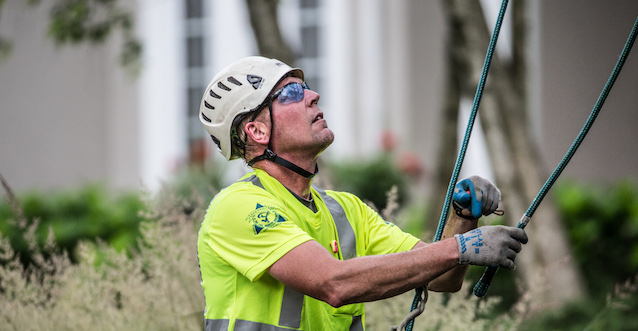
Would you like to know one of the first certified arborists in the United States?
Meet Joe Kramer. He was in the inaugural Certified Arborist class offered by the International Society of Arboriculture (ISA). The number on his arborist credential is 35.
“If my name was Adam Anderson, I would be No. 1,” Kramer says.
So perhaps it was inevitable that his tree care business, Kramer Tree Specialists Inc., would emphasize professional credentials.
One-third of staff has a certification
Of the 69 full-time employees the West Chicago tree service had earlier this summer, 17 were ISA Certified Arborists®. Another five were Certified Treecare Safety Professionals (CTSP), which is offered by the Tree Care Industry Association. And one was an ISA Board Certified Master Arborist®, the highest level of certification offered by the organization.
That’s 23 certifications on a staff of 69. Even the office manager is a Certified Arborist.
It’s easy to draw a connection between this emphasis on learning and safety and the success of Kramer Tree Specialists, which Kramer started more than 40 years ago.
“We want people to have a sense of making a contribution to the company and to the industry,” Kramer says. “We want people to have a sense that they can rise in our company. When our staff members attain certifications, there are salary increases.”
Staying atop industry trends
As the saying goes, happy employees make happy customers. It’s more than employees being well-compensated and feeling professionally satisfied, however. What they learn through the certification process (and the ongoing educational opportunities then made available to them) obviously helps them on the job.
“It’s an evolving industry, and what we need to know is continually increasing — insects, disease, changes in safety practices,” says Seth Balvanz, sales and marketing manager at Kramer Tree Specialists.
Like all of the company’s sales staff, Balvanz is a Certified Arborist. It’s required.
“They’re the ones ultimately giving the recommendations of what needs to be done on a job,” says Paul Filary, who is, you guessed it, a Certified Arborist. “And from our standpoint, we think they have to have the knowledge and experience in order to be able to provide suitable recommendations for clients.”
Attracting customers and employees
This has helped Kramer Tree Specialists win jobs. Customers appreciate when a sales team member understands their needs and concerns and can respond with knowledgeable and insightful solutions.
Sometimes, homeowners and commercial customers will only consider tree care companies that have employees with professional credentials. For instance, Kramer says many municipalities in his area require an arborist be on the jobsite. Also, his company has a commercial client that demands a Board Certified Master Arborist be present while crews work.
The emphasis on certification also helps Kramer Tree Specialists attract and retain employees, which is one of the biggest challenges in the tree care industry.
“The opportunity for professional development, one, it’s good for anybody’s career and, two, it’s good for attracting potential employees because there are these opportunities available to them,” Filary says.
Kramer pays an employee’s expenses related to certification, such as fees and training materials. Employees who achieve certification receive a pay increase.
“What we really are hopeful for is that when one employee sees that another employee has reached a certain level and has gotten compensated accordingly, that it encourages others,” Kramer says. “We encourage this any way we can and on every level.”
A ‘professional edge’
Filary says being certified opens up other educational opportunities, such as seminars, that further build upon the professionalism of the staff.
“It helps to maintain that professional edge or hunger,” he says.
That’s been the case for Kramer himself. He created Kramer Tree Specialists in 1974. He was ISA Certified Arborist No. 35. Now there are more than 30,000 worldwide.
“It’s just a team spirit here,” he says. “One Certified Arborist walking down the hall may see another Certified Arborist, and there’s a little bit of a knowing look between them. So it’s a team reinforcement thing.”