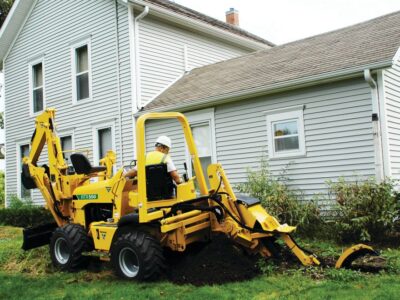
Ride-on tractor trencher selection isn’t just about horsepower — it’s a careful balance of trench depth and width, ground conditions, attachment type and footprint. Choosing the best ride-on trencher is critical for efficiency and productivity on a variety of projects, from residential home drops to long-run utility installations.
“If the footprint size is not an issue, size the tractor for the worst-case scenario,” Vermeer Product Manager Nick Olsen said. “You can only cut to the limitation of the rock wheel diameter or boom length.”
How does trench depth and width influence ride-on trencher choice?
“The digging depth and width determine the size of the boom a contractor needs, but they can also affect the size of the ride-on trencher required,” Olsen said “Digging deeper and wider requires more horsepower than shallower and narrower digging in similar ground conditions.”
The dimensions of the conduit, cable or pipe being installed dictate the trench size. Operators often aim for the shallowest, narrowest trench possible to minimize ground disturbance, especially when working in residential areas.
This has led to the increasing popularity of microtrenching for fiber optic installation in urban environments. The process involves cutting a trench from 3/4 in to 2 in (19.1 to 50.8 mm) wide and 8 to 17 in (20.3 to 43.1 cm) deep. For microtrenching applications, a Vermeer microtrencher attachment can be added to an RTX550 or RTX750 ride-on tractor.
“Selecting the best ride-on trencher for microtrenching depends on ground conditions,” said Olsen. “If you are cutting asphalt over soft dirt, the RTX550 works well. If you’re going to be running into some rock and concrete underneath, you will probably be happier with the RTX750. While there is not a huge difference in horsepower, it does make a difference.”
Wider, deeper trenches require ride-on trenchers with more horsepower and heavier weight to maintain productivity. The maximum digging width depends on the tractor model and trenching attachment. For instance, an RTX450 ride-on tractor may cut a trench up to 12 in (30.5 cm) wide and 60 in (152.4 cm) deep, while the RTX1250 ride-on tractor may cut a trench up to 18 in (45.72 cm) wide and 72 in (182.8 cm) deep.
How does horsepower depth impact ride-on trencher productivity?
Trencher horsepower must align with both trench dimensions and expected productivity. More horsepower allows faster trenching when performing longer cuts, but larger machines also have bigger footprints that may not be suitable for tight residential areas.
“If you keep the horsepower constant, the productivity diminishes as you cut deeper and wider,” Olson explained. “Ground conditions, width and depth are going to dictate what horsepower tractor you bring. Vermeer covers the full range of utility applications with ride-on tractors ranging from the 49-hp RTX450 to the 127-hp RTX1250 and steel-track XTS1250.”
How do ground conditions influence ride-on trencher selection?
Smaller, lighter machines are ideal for isolated cuts in dirt or clay. Heavier machines handle tougher soils and deeper trenches more effectively.
“It’s a delicate dance with ground condition, product size and footprint that you need to achieve,” said Olsen.
Serving rural communities with fiber installation presents a large opportunity. The footprint on a machine increases as horsepower increases. However, these larger ride-on trenchers can maximize productivity when plowing larger stretches of fiber in soft, loose, well-aerated soil across the rural Midwest.
Similarly, larger tractors equipped with rock wheels provide an efficient method of fiber installation in parts of the Midwest, the South, the Southwest and the East Coast.
When plowing, maximum tractive effort optimizes productivity. The XTS1250 ride-on tractors provide maximum tractive effort for plowing with their steel tracks.
“The steel tracks really bite the soil and give you good productivity,” said Olsen.
How do attachments influence tractor sizing?
Different attachments — trenchers, microtrenchers, plows or rock wheels — require specific tractor capabilities:
- Trenchers: Chain trenchers excel in softer and mixed soils. Tractor size depends on width, depth and production rate.
- Microtrenchers: These attachments are designed to optimize small-diameter product installation in urban environments. The MTR516 attachment can be paired with the RTX550 or RTX750.
- Plows: Useful for long runs or residential drops; mid- to high-horsepower tractors are preferred for efficiency.
- Rock wheels: Require more powerful machines for cutting through cobble, light rock or asphalt. For example, the RTX550 can handle 26-inch (66.0-cm) wheels, the RTX750 has 26- and 32-inch (66.0- and 81.3-cm) wheels and the RTX1250 supports 36-, 40- and 52-inch (91.4-, 101.6- and 132.1-cm) wheels.
Attachment popularity is largely dependent upon regional ground conditions. In the U.S., the South and West tend to have rocky soils, while the Midwest and East have softer and mixed soils.
“Rock wheels are very popular in Texas, California and other Western regions. In the Midwest and East, the vibratory plow and chain trencher are really popular,” said Olsen.
How do I know if a ride-on trencher is sized properly for my application?
In addition to trench depth and width, the total length of the installation and available space will influence ride-on tractor sizing.
“If you are going to plow a mile a day, you are probably going to be best served by the RTX1250. If you are on tighter roadways on the East Coast with smaller ditches, the RTX750 may be a good option,” said Olsen.
Vermeer offers a full range of ride-on trenchers for trenching applications:
- RTX450: Suitable for narrow, shallow trenches in softer soils.
- RTX550 and RTX750: Ideal for medium-depth trenches or tougher soils, including asphalt or light rock
- RTX1250: Handles deeper, wider trenches and heavy-duty applications.
Given the many variables — soil type, trench dimensions, attachments, footprint and desired productivity — consulting a local Vermeer dealer is recommended. They can help ensure the ride-on trencher is sized correctly for your intended applications, whether it’s fiber deployment in rural areas or microtrenching in cities.
Properly sizing a ride-on trencher requires more than matching horsepower to trench size. Operators must consider trench depth, width, soil conditions, machine footprint, attachments and productivity goals. By sizing for the most demanding jobs and leveraging attachment versatility, contractors can optimize efficiency, minimize downtime and achieve reliable, high-quality results.
Vermeer Corporation reserves the right to make changes in engineering, design and specifications; add improvements; or discontinue manufacturing at any time without notice or obligation. Equipment shown is for illustrative purposes only and may display optional accessories or components specific to their global region. Please contact your local Vermeer dealer for more information on machine specifications. Vermeer and the Vermeer logo are trademarks of Vermeer Manufacturing Company in the U.S. and/or other countries.
© 2025 Vermeer Corporation. All Rights Reserved.