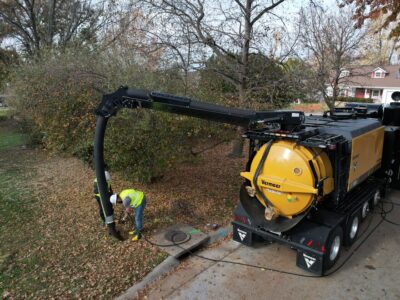
For municipalities managing aging infrastructure and utility contractors tackling large-scale excavation work, Vermeer vacuum trucks can be a strong fit for productive digging.
From the 4,131-cfm (117-cubic-m/min) VXT400 to the 6,400-cfm (181.2-cubic-m/min) VXT600, the Vermeer VXT lineup is built to deliver the vacuum power, spoil capacity and jobsite mobility crews need for demanding work. If you’re comparing vacuum trucks and trying to determine whether a Vermeer vac truck is the right fit for your operation, here are answers to common buying questions.
What is a vacuum truck, and how is it different from a trailer vac?
A vacuum truck is a self-contained unit mounted on a truck chassis. Unlike trailer vacs, which require a separate tow vehicle, vac trucks combine transport and excavation capability in one mobilized machine.
That can mean:
- Fewer vehicles to manage
- Simpler logistics between jobsites
- Faster setup once the crew arrives
Compared with trailer-mounted units, vacuum trucks can also offer higher suction capacity, larger spoil tanks and greater water volume. That makes them a practical choice for extended, high-production excavation work.
What jobs are Vermeer VXT vacuum trucks designed for?
The Vermeer VXT lineup is built for applications that demand sustained performance, strong suction and efficient debris handling.
Common uses for Vermeer vacuum trucks include:
- Lead pipe mitigation: Lead service line replacement is no longer optional. Having the right equipment can help crews keep pace with replacement work and excavate accurately around existing underground infrastructure.
- Municipal infrastructure maintenance and repair: Water, sewer and stormwater crews use vacuum trucks to expose utilities, clean lift stations and manage debris during emergency repairs while minimizing risk near buried lines.
- Utility installation: Exposing buried gas, electric, fiber and water lines before new construction is one of the most common uses for vac trucks, especially when crews need to pothole accurately in compacted soil.
- Large-scale hydro excavation: When projects involve moving significant volumes of material over long periods, vacuum trucks with larger spoil tanks and higher airflow can help reduce dump cycles and keep production moving.
- Emergency utility repair: When a water main breaks or a gas line must be accessed quickly, vac trucks can mobilize fast without the extra setup associated with trailer-mounted equipment.
- Industrial and commercial excavation: Refineries, commercial developments and industrial facilities often require precise excavation in tight work zones. A vac truck can help crews excavate accurately while minimizing disruption.
Other applications where vacuum trucks can perform well include:
- Non-destructive excavation around sensitive underground infrastructure
- HDD fluid management and cleanup
- Slot trenching or hydro trenching for utility installation
- Sign and pole installation
- Wet or dry debris removal
- Excavation in restricted-access work areas
- Foundation and footing excavation
- Landscaping and soil removal with limited disruption
What are the key specs of Vermeer VXT vacuum trucks?
If you’re comparing top vacuum trucks, here’s a high-level look at the VXT lineup.
VXT400 vacuum truck
The VXT400 vacuum truck delivers 4,131 cfm (117 cubic m/min) and combines strong suction with a low-profile design that can help crews work in tighter jobsites while limiting unnecessary trips.
Key features include:
- Three spoil tank options
- Two freshwater tank options
- A 25-ft (7.6-m) dig tube with 330-degree rotation
- Dual-dig capability for two operators
- 3,000 psi (206 bar) water pressure at 10 gpm (38 L/min), with optional 19.4 gpm (73 L/min)
- Optional patent-pending WorkZone™ 360 camera system with boom reach radius overlay
- 50-degree tank tilt, cam-over hydraulic rear door dump and spoil tank vibrator for easier cleanup
VXT500 vacuum truck
The VXT500 vacuum truck delivers 5,018 cfm (142 cubic m/min) and builds on many of the same strengths as the VXT400 while increasing airflow and vacuum power to 27 inHg (0.91 bar).
Optional features available on both the VXT400 and VXT500 include:
- Heated water plumbing
- Spoil tank vibrator
VXT600 vacuum truck
The VXT600 vacuum truck is the highest-powered model in the VXT lineup, delivering 6,400 cfm (181.2 cubic m/min) for demanding excavation work.
Compared with its previous version, the current VXT600 — at 40,000 lb (18,144 kg) dry weight — is nearly 7,000 lb (3,175.1 kg) lighter, helping improve hauling efficiency. It also leads the lineup in:
- Airflow
- Water capacity at 1,200 gal (4,542 L)
- Vacuum reach at 23 ft (7 m)
To see the full lineup in one place, review the specs on Vermeer vacuum trucks.
Why are municipalities choosing vacuum trucks over traditional digging methods?
Many municipalities are shifting to vacuum trucks because of damage prevention, infrastructure density and cost control.
- Damage prevention: Utility corridors are increasingly congested with water, gas, electric, telecom and fiber lines. Using a vac truck for non-destructive excavation can expose utility lines while minimizing the risk of a line strike.
- Regulatory alignment:
- Minimize restoration costs: Because vacuum trucks can create a more controlled excavation area than mechanical digging, crews may disturb less pavement, turf and landscaping.
What should utility contractors compare when evaluating vacuum trucks?
When comparing vacuum trucks, the most important specs depend on the work you do most often. Focus on these factors:
- Suction power (CFM and vacuum rating): Higher CFM helps move more material. Vacuum rating matters when lifting heavier, wetter spoil or working in dense soils.
- Spoil tank capacity: Larger tanks can mean fewer dump trips and more productive work time.
- Water tank capacity: For hydro excavation, more onboard water can extend run time between refills.
- Jobsite mobility: Self-contained vac trucks can move efficiently between sites without the need for a trailer.
- Dealer support and parts availability: The Vermeer dealer network can help with parts, service and support when uptime matters.
How do Vermeer vacuum trucks compare with trailer-mounted vacs?
Vermeer offers trailer vacs and lighter truck-mounted options for a range of applications. Smaller units can be a strong fit for tight-access residential work and lighter commercial jobs.
But Vermeer vacuum trucks in the VXT lineup are built for more demanding applications. If your crews regularly work in compacted or clay-heavy soil, handle deeper excavations, support multiple operators or lose production time to frequent dump cycles, a larger vac truck may optimize your productivity.
To review the Vermeer lineup, explore our vacuum excavation options.
What CFM and hose size are best for my vacuum truck application?
CFM measures the volume of air moved through the vacuum system and directly affects how a vacuum truck performs with different hose diameters.
The goal is to maintain enough airflow velocity to keep material suspended from the dig point to the tank. If material settles in the hose, productivity can decrease and clogging risk rises.
- 6-in (15.2-cm) hose: Often suited for high-volume material movement on larger municipal projects, deeper excavations and longer potholing runs in dense soil.
- 8-in (20.3-cm) hose: Designed for demanding work where crews need to move large amounts of material efficiently without sacrificing airflow performance.
What spoil tank size is best for my work?
Spoil tank capacity should match your typical application, haul distance and production goals.
Across the VXT lineup, spoil tank options scale with machine capability. When comparing vac trucks, consider:
- Job duration
- Soil conditions
- Transportation requirements
- Water-to-spoil ratio
Available spoil tank capacities include:
- 8 cu yd (6.1 cu m)
- 10 cu yd (7.6 cu m)
- 12 cu yd (9.2 cu m)
What vac truck options should I consider?
A better question may be: What does your work demand from a vacuum truck?
One advantage of the VXT lineup is the range of model and option combinations available. That means you can configure a Vermeer vacuum truck around the way your crew works rather than forcing your crew to adapt to the machine.
Key considerations include:
- Water pressure and flow
- Dig tube dimensions
- Freshwater and spoil tank capacity
- Hose diameter
- Dual-operator capability
- Cold-weather package availability
- Camera and visibility systems
- Reverse flow for faster tank unloading
Need two operators working from one machine? Certain VXT configurations support dual-operator productivity without increasing your equipment footprint.
Working in cold conditions? A cold-weather kit can help protect critical systems when temperatures drop.
The available camera setup system with boom reach radius overlay can also help reduce setup guesswork and improve positioning efficiency.
For high-volume operations, the reverse flow option can help speed spoil unloading and reduce turnaround time at the dump site.
Bottom line: Your local Vermeer dealer can help match the right vac truck configuration to your application.
What training do vacuum truck operators need?
Proper training matters for efficient vacuum truck operation. New operators should understand:
- Equipment orientation and controls
- Proper potholing techniques
- Basic troubleshooting and maintenance
- Ground disturbance practices
- Utility locating and marking system awareness
One advantage of the VXT lineup is operating familiarity across the series. Because the models share core operating standards, operators trained on one machine can transition smoothly across the lineup.
Does Vermeer support vacuum trucks after the sale?
Yes — and that ongoing support is one reason contractors and municipalities continue investing in Vermeer vacuum trucks.
With more than 600 locations worldwide, Vermeer support includes:
- Factory-trained technicians
- Dealer parts inventory
- Dealer-sponsored operator training
- Territory support with vacuum excavation expertise
How do I know which Vermeer vacuum truck is right for my operation?
The best place to start is with your job mix. Think through:
- Typical soil conditions
- Crew size
- Dig depth
- Material volume
- Travel distance between jobs
- Water and spoil capacity needs
Then connect with your dealer to compare the right Vermeer vacuum truck for your operation. Whether you need a higher-capacity machine for municipal infrastructure work or a vac truck built for sustained hydro excavation productivity, the right fit starts with the work you do every day.
Ready to dig in? Find your local Vermeer dealer.
Vermeer MV Solutions, Inc. reserves the right to make changes in engineering, design and specifications; add improvements; or discontinue manufacturing at any time without notice or obligation.
Equipment shown is for illustrative purposes only and may display optional accessories or components specific to their global region.
Please contact your local Vermeer dealer for more information on machine specifications.
Vermeer, the Vermeer logo,Equipped to Do More and WorkZone are trademarks of Vermeer Manufacturing Company in the U.S. and/or other countries.
© 2026 Vermeer Corporation. All Rights Reserved.