There is no single playbook for dominating utility installation. With tight budgets and even tighter deadlines, every project manager is asking the same question, “What’s the fastest way to get conduit in the ground without breaking the bank?”
The answer is simple: It depends.
To be sure, the best method depends on your specific job. What’s best for one install may become Plan B for the next job around the corner.
But here’s what we know for certain. Crews that are equipped to alternate between microtrenching and horizontal directional drilling for utility installation have a massive advantage.
Microtrenching is where speed meets precision
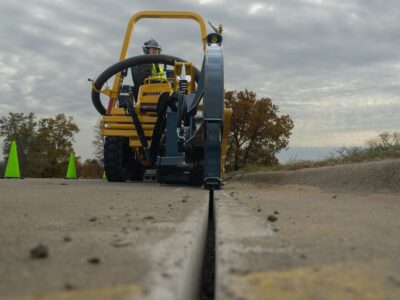
Imagine a razor-thin cut along the curb line, conduit placed with surgical precision and traffic flowing again before lunch. That’s microtrenching at its best.
Vermeer microtrencher attachments slice narrow slots — typically 0.75 in to 2.25 in (1.9 cm to 5.7 cm) wide and up to 17 in 43.2 cm) deep — right where you need them. Pair that with a vacuum excavator to keep spoil contained, finish with grout or epoxy backfill and you’ve got a restoration that matches the original roadway.
The microtrenching sweet spot? Short, straightforward runs on compatible pavement. Recent Fiber Broadband Association data shows microtrenching averages $14.51 per foot, which is competitive with traditional methods and often faster to execute. When you’re working residential streets with sound asphalt, microtrenching delivers speed with cost control.
But here’s the catch — microtrenching isn’t a universal solution. Many agencies limit it to asphalt edges and residential areas and require you to avoid wheel paths. Need to cross a major corridor or go deeper for installation? Time to switch tactics.
Directional drilling the underground highway
Horizontal directional drilling plays by different rules. Instead of opening the surface, utility installation crews drill a steerable pilot hole, enlarge it, then pull conduit through at the depth and alignment the job demands.
This is your go-to when surface disruption isn’t an option. Need to cross under a highway, railway or waterway? HDD handles it. Working in areas where permits restrict surface cuts? HDD delivers. The method scales from smaller rigs handling runs as shallow as 2 ft to 4 ft (0.6 m to 1.2 m) deep and under a 100 ft (30.5 m) in distance to massive projects with maxi rigs pushing 15,000+ ft (4,572+ m) long under major infrastructure.
The trade-off? HDD requires more planning, specialized drilling fluids for challenging ground conditions and modern guidance systems to keep bores on target. But when executed properly, HDD places conduit exactly where engineers designed it, regardless of what’s happening on the surface.
Making the call between the two methods
Choose microtrenching when:
- Working residential streets with quality asphalt
- Running short, linear installations near curb lines
- Permits allow surface cuts and restoration
- Shallow depths are preferred or required
- Ground conditions are straightforward
Switch to HDD when:
- Projects require deeper cover or engineered undercrossings
- Surface disruption is restricted or prohibited
- Crossing major roadways, rail lines or waterways
- Distance requirements exceed practical microtrenching limits
The accuracy showdown
Here’s where definitions matter. Microtrenching wins on surface accuracy, as the conduit sits exactly where you cut the slot. No guesswork, no variance. HDD wins on subsurface precision, using walkover tracking, wireline or gyroscopic guidance to hit designed alignments at depth.
Both methods deliver accuracy, but they’re measuring different things. Choose based on what your project actually requires.
Ground truth in soil and surface conditions
Microtrenching is a great fit for sound asphalt but requires the right cutting tools for different surfaces. Segmented wheels handle concrete better than PDC wheels, which excel in asphalt applications. Know your pavement type before you cut.
HDD adapts across soil types but faces challenges in mixed ground, cobbles and fractured rock. These conditions demand specialized planning, drilling fluids and HDD tooling — factors that can impact both timelines and budget.
Distance and production considerations
Microtrenching distance is typically limited by traffic control, permits and daily production capacity rather than equipment capability. Plan your spoil handling and match vacuum capacity accordingly.
HDD ranges depend on rig classification. As mentioned above, small to midsize HDDs can handle most utility work under 1,000 ft (304.8 m), while larger rigs can push thousands of feet when conditions allow. The key is matching rig capacity to project requirements.
Industry momentum for both growing methods
The market isn’t picking winners. Instead, it’s getting smarter about tool selection. The 2024 Underground Infrastructure HDD Survey shows steady demand for drilling equipment, while microtrenching has evolved from an experimental technique to a proven method.
This trend reflects a maturing industry that chooses the right tool for each specific challenge rather than defaulting to one-size-fits-all solutions.
The bottom line is plan first, execute flawlessly
The best method for your next job depends on pavement type, permit requirements, ground conditions and project scope. Microtrenching delivers speed and cost efficiency for compatible applications. HDD provides depth and crossing capability when surface methods won’t work.
Both methods succeed when properly planned and executed with the right equipment. Whether you’re cutting slots or steering bores, your success depends on having the right equipment, proper planning and reliable support when you need it most. That’s Vermeer.
Ready to cut and bore with confidence? Your Vermeer dealer has the equipment and expertise to keep your projects moving forward — no matter which method the job demands. Confidence is knowing you’re working with 24/7 parts availability, mobile service trucks, certified technicians, app support and the VermeerOne digital platform.
Contact your local Vermeer dealer today for guidance on your next job.