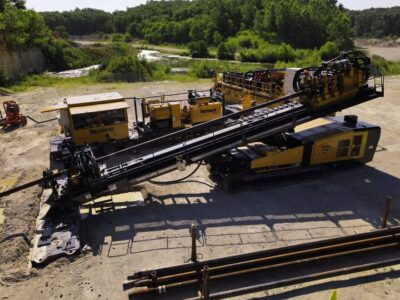
Proper tooling selection, application and maintenance play a key role in large-diameter directional drilling success. In this pipeline tooling guide, Vermeer product experts and their strategic distribution partner, Right Turn Supply, share insights to help you maximize drilling productivity. Both Vermeer and Right Turn Supply offer a range of tooling solutions and technical expertise. In this guide, they answer common questions, including how to choose the right tooling, estimate tooling lifespan, identify worn tooling and budget for tooling wear and tear.
How do I choose the right tooling for a pipeline project?
Selecting the right tooling starts with understanding project specifics ⏤ including ground conditions, drilling fluids and rig capacity ⏤and making them work together.
Formations
It’s all about matching your tooling to the ground conditions you’re drilling in.
“A bit for soft rock will wear out prematurely in hard, abrasive material,” explained Christian Rich, regional manager at Right Turn Supply. “A bit for hard rock is going to last longer in hard rock, but it will be slower production-wise and take a less aggressive bite in softer material.”
Ground data
There’s more to understanding ground conditions than soft or hard formations. Bore samples or geotechnical reports can help identify the right tooling based on the hardness, abrasiveness and composition of the ground. If samples aren’t available, use local references like nearby quarries or experienced drillers for insight.
“Depending on the bore depth, you can go from a soft loam clay into sand and then into a hard rock,” said Ken Coffield, solution specialist at Vermeer Southeast. “The tooling is going to be based on your worst-case scenario.”
Rig capacity and performance
Rig size and pump capacity dictate how much material a tool can cut efficiently.
Smaller rigs may lack the torque or pullback force needed to engage cutters properly. Operators often compensate by spinning tools faster, which creates extra heat, friction and premature wear. A rig with adequate pullback force and rotational torque allows for slower, steady rotation, especially when combined with the right mud pump capabilities, pressure and flow. Together, they maximize both tool life and productivity.
Drilling fluid
Tooling selection is closely tied to an operation’s drilling fluid program. The right fluid:
- Keeps the hole stable.
- Carries cuttings efficiently.
- Provides cooling and lubrication to extend tool life.
Crews also need to find the right tooling nozzle configuration, especially for large-diameter bores, to prevent erosion and manage flow. The angle of the nozzles can help prevent erosion of softer or sandy formations by directing high-pressure mud parallel to the bore path.
“Proper nozzle selection creates turbulent flow at the cutting face, then smooth laminar flow up the annulus to carry cuttings out,” said Mark Hutchinson, field operations manager at Right Turn Supply. “Pump flow is another important consideration. If you can’t cut it and get it out of the way fast enough, then either you need to take a smaller bite, or you need to pull the reamer slower to get good hole cleaning and annular velocity.”
Matching your tooling to your work can be complex, but a Vermeer dealer can help. Share your project specs, ground data and equipment details with your local dealer to get guidance on the best solution.
What are the best reamers for large-diameter bores?
Reamers are formation-specific and need to be configured accordingly to maximize production and wear life. Sand, clay and rock all require certain reamer characteristics.
“If you’re using a maxi rig, you normally have a whole trailer of different reamers,” said John Delong, sales support specialist at Vermeer Texas-Louisiana. “You’ll have different heads for the drilling out, different kinds of adapters and a trailer full of reamers.”
For larger diameter bores, reamer selection focuses on cutter type, placement and optimizing fluid flow through the addition of more and/or larger jets to ensure proper hole cleaning and annular velocity. The significant volume of cuttings and mud that needs to be moved in large holes make efficient fluid management and appropriate reamer selection crucial.
Choosing the proper step-up sizes helps maximize productivity. The final reamer size should be 1.5 times the diameter of the product size up to 14 in (35.56 cm). It should be 1.3 times the diameter of pipes measuring more than 14 in (35.56 cm) in diameter.
“Pilot and final hole sizes are usually pre-determined. Steps between may not have been laid out. Based on the rig size, we try to recommend the ideal step-ups,” said Rich.
What’s the lifespan of HDD tooling on a pipeline job?
Tool life varies with rock hardness, drilling speed and fluid efficiency. Meanwhile, performance factors like rotation speed, weight on bit, pullback rate and annular cleaning all affect lifespan. Generally, the slower you can spin the tool while maintaining good production, the longer it lasts.
“What determines rock tooling life is how many revolutions it goes through in the ground,” said Rich. “If the soil is abrasive and you’re not pumping cuttings out of the bore fast enough, that’s going to accelerate wear. If you are spinning faster than you need to get production, then you’re going to wear out tools prematurely.”
Using a rig with insufficient capacity can also lead to premature tool wear through heat and friction. The right mud can extend the life of drill bits by cooling them.
There are too many variables to pinpoint the exact life of a given tool. But a tooling expert can factor in your drilling conditions to calculate an estimated life expectancy. You can also learn more about your tooling by tracking tool hours in a drilling log. This can help you anticipate bearing or seal failures.
What are the signs that your tooling is worn out?
Signs of worn tooling include:
- Slower drilling.
- Increased rotational pressures.
- Poor rock cutting.
- Debris accumulation.
- Visible wear.
If you’re drilling at a steady rate and production slows over time, it’s an indication that the tool is not performing optimally and likely showing wear in critical areas.
Examine the cutting structure of drill bits and reamers for signs of erosion, like flattened, misshapen, cracked or broken carbide inserts, every time the tool is removed from the borehole. Preventive maintenance includes checking for cracks, hourglass wear on the shaft, proactively replacing missing teeth and rebuilding worn hard metal areas on all tools.
“Good preventive maintenance can make a dirt tool last a long time. This includes building up worn areas and replacing teeth,” said Rich. “If you get to where the shaft is showing a lot of wear, has a crack in it, the metal is getting thin or the centralizing ring is starting to lose some thickness, then you want to replace it.”
How much should I budget for tooling wear and tear?
Instead of a fixed number, budget for wear and tear by working with a tooling expert to estimate the tool lifespan. Calculate the number of tools required by dividing the total job length by the expected tool life. Multiply this by the tool cost and add 10% to 20% for unexpected wear or tough formations.
If a tool lasts 2,000 ft (609.6 m) in hard rock and the bore is 3,000 ft (914.4 m), you’d budget for at least two tools, plus a contingency. Tool life varies with rock hardness, drilling speed and fluid efficiency. Suppliers often estimate expected tool hours or cycles. This helps you budget and plan.
Economy and premium tooling options will impact the overall budget. Premium tools cost 40% to 50% more but offer better performance and longevity. This upfront investment can pay dividends in the long term.
Are you ready to configure the tooling plan for your next pipeline job? Work with your Vermeer dealer pipeline specialist to choose the right tooling and fluid management for your needs.
This article contains third-party observations, advice or experiences that do not necessarily reflect the opinions of Vermeer Corporation, its affiliates or its dealers. Testimonials and/or endorsements by contractors in specific circumstances may not be representative of normal circumstances experienced by all customers.
Vermeer Corporation reserves the right to make changes in engineering, design and specifications; add improvements; or discontinue manufacturing at any time without notice or obligation. Equipment shown is for illustrative purposes only and may display optional accessories or components specific to their global region. Please contact your local Vermeer dealer for more information on machine specifications. Vermeer and the Vermeer logo are trademarks of Vermeer Manufacturing Company in the U.S. and/or other countries.
© 2025 Vermeer Corporation. All Rights Reserved.