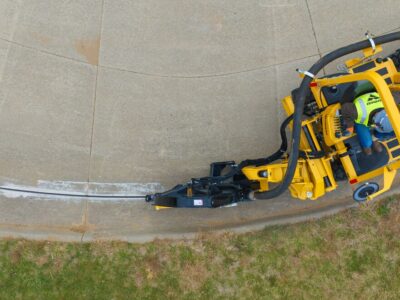
Not every fiber installation project has the same depth requirements. Most contractors cutting residential streets work at 16 in (40.6 cm) or less, and the MTR516 microtrencher handles that work. But some projects demand more.
Municipal codes vary. Some jurisdictions require greater depth of cover for fiber conduit, especially near existing utilities or under certain pavement types. When engineers create specs and the drawings call for more than 17 in (43.2 cm), contractors need equipment that can deliver.
That’s where the MTR726 microtrencher comes in.
Cutting deeper for demanding fiber installation projects
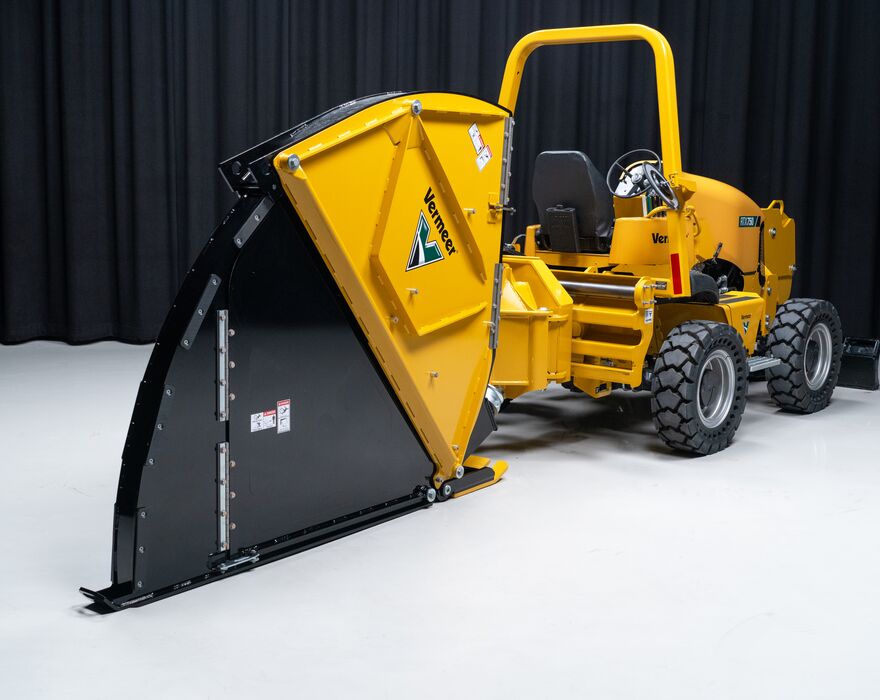
The MTR726 microtrencher attachment cuts up to 27 in (68.6 cm) deep and up to 3 in (7.6 cm) wide. It’s built for the RTX750 ride-on tractor, which provides the power needed for deeper cuts through asphalt.
“It’s really just a big brother to the MTR516,” said Nick Olsen, product manager at Vermeer. “All the features and benefits transfer over.”
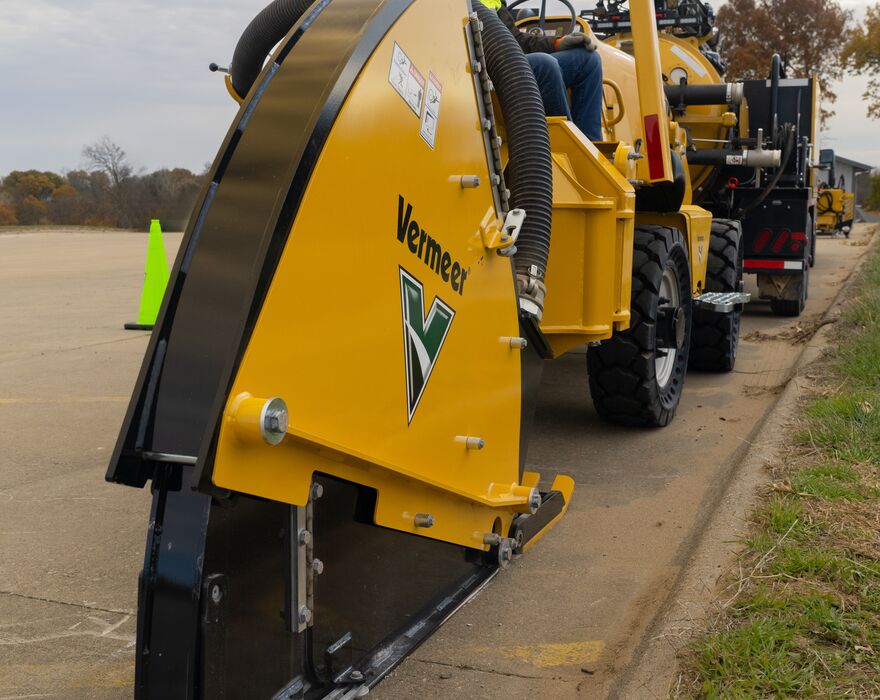
That means contractors get the same fully shrouded cutting wheel that covers the blade during operation, contains debris and optimizes vacuum suction. Multiple bolt-in wear plates are field-serviceable, and a dual-hinged access panel gives unhindered access for blade servicing and replacement. The replaceable spoil outlet accommodates 4 in or 6 in (10.2 cm or 15.2 cm) vac hoses.
The MTR726 also features single-lever depth control and up to 24 in (61 cm) of right offset for cutting next to curbs.
MTR516 vs. MTR726: Matching the microtrencher to the project
The decision comes down to project requirements.
Choose the MTR516 when:
- Projects require depths up to 17 in (43.2 cm)
- You need compatibility with RTX550 or RTX750 tractors
- Maneuverability and lighter weight matter for your jobsites
- Most of your work is standard residential fiber installation
Choose the MTR726 when:
- Projects require depths between 17 in and 27 in (43.2 cm and 68.6 cm)
- Municipal codes or engineering specs demand greater depth of cover
- You’re running an RTX750 tractor
Productivity without compromise
The MTR726 doesn’t sacrifice the benefits that make microtrenching efficient. Contractors still get a narrow trench compared to traditional methods, which means less cutting, less backfill and less restoration work. The shrouded wheel design helps keep debris contained, reducing cleanup time in urban environments where minimizing disruption matters.
Wheels with welded polycrystalline diamond cutter (PDC) teeth deliver fast, clean cuts in asphalt applications. And because the attachment shares design DNA with the MTR516, crews familiar with one can be productive on the other quickly.
Ready to go deeper on your next fiber project?
For contractors whose projects require greater depth of cover, the MTR726 microtrencher delivers the capability without abandoning what makes microtrenching productive. Paired with Vermeer mini loader attachments like the core saw for utility exposure and the concrete reinstatement attachment for backfill, contractors can handle the complete microtrenching workflow. Contact your local Vermeer dealer to learn more about matching the right microtrencher to your project requirements.
Vermeer Corporation reserves the right to make changes in engineering, design and specifications; add improvements; or discontinue manufacturing at any time without notice or obligation. Equipment shown is for illustrative purposes only and may display optional accessories or components specific to their global region. Please contact your local Vermeer dealer for more information on machine specifications.
Vermeer and the Vermeer logo are trademarks of Vermeer Manufacturing Company in the U.S. and/or other countries. © 2026 Vermeer Corporation. All Rights Reserved.