The problem was hiding in plain sight.
Vermeer had spent years on solar jobsites with pile drivers, watching how contractors moved from one installation point to the next. But before those machines could drive a pile, another crew often had to deliver it, offload it and get it close enough to the planned position. That work usually involved skid steers, track loaders or telehandlers, and it often required multiple people around heavy piles.
The inefficiency was not dramatic.
No, it was monotonous.
One pile. Then another. Then hundreds more.
Put it all together, and the problem became clear.
“When the pile driver comes along, those operators like to have the pile located at a certain distance from the waypoint,” said Ed Savage, product manager at Vermeer. “Shaking them off with a skid steer or having people drop them off the skid steer, the accuracy is not very good because they’re just getting them close.”
That repeated handling added up across large solar jobsites.
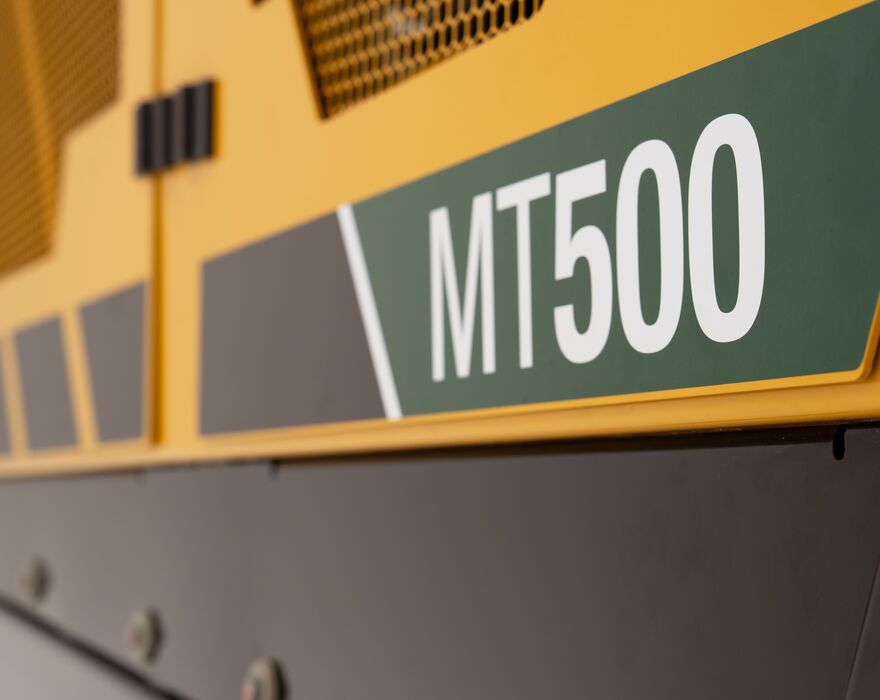
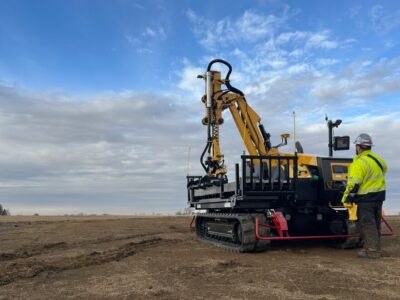
That inefficiency shaped the design challenge for the Vermeer MT500 material transporter: create a machine that could carry piles across the solar field, place them with more consistency and reduce how often crews needed to manually handle them. The result was a new type of Vermeer machine developed for ground-mounted, utility-scale solar jobsites, capable of delivering and placing 10 ft – 25 ft (3.05 m – 7.6 m) piles with one operator remotely running the machine.
Let’s go behind the design to understand why the MT500 was created, how it was engineered and what it is designed to do.
What problem does the MT500 material transporter solve on solar jobsites?
On a ground-mounted solar project, pile layout is one of those steps that can dictate the rhythm of everything that follows.
Before piles can be driven, they have to be moved from staging areas and placed near planned positions across the solar field. For many contractors, that process has relied on skid steers, telehandlers or track loaders. It is labor-intensive work, and consistent placement can be difficult to achieve at scale.
The piles themselves are not small. The MT500 was developed to handle W-beam piles up to 400 lb (181.4 kg) each, with a total payload of up to 5,000 lb (2,268 kg). That scale made pile handling more than a logistics question. It became a productivity, consistency and crew-efficiency challenge.
Savage said customers were concerned about how often crew members had to touch each pile during layout.
“Typically it’s a three-person crew,” Savage said. “But you think about all the times they have to touch the pile to make that happen.”
For Vermeer, the opportunity was not to make another pile driver. It was to improve the process that feeds the pile driver.
What is the Vermeer MT500 material transporter?
The MT500 material transporter is a machine for ground-mounted, utility-scale solar jobsites that delivers and places W-beam piles. It is designed to handle 10 ft – 25 ft (3.05 m – 7.6 m) piles weighing up to 400 lb (181.44 kg) each, with a total payload of up to 5,000 lb (2,267.96 kg). One operator can remotely run the machine with the push of a button.
The machine uses an automated arm to pick and place piles. It is compatible with third-party GPS systems and uses point-to-point and row-to-row automation to move across the solar field.
That matters because solar pile layout is repeated hundreds or thousands of times across a jobsite. The MT500 was developed to help contractors place piles more consistently while reducing manual pile handling during the layout process.
Instead of relying only on traditional shakeout methods, the MT500 brings automation into a repeated step of the solar construction process. For contractors working across large solar fields, that consistency can help the next operation keep moving.
How did customer feedback shape the MT500 material transporter?
The MT500 did not begin as a finished machine. It began as a question Vermeer had to answer with customers: Could a machine mechanize and automate a jobsite step that had long depended on skid steers, loaders and crew members manually positioning piles?
Grant Fidler, who worked as a project engineer on the MT500’s development, said one of the early risks was determining whether the concept truly met the market need.
“We’ve never built a pile placer before. We’ve never built a material transporter before,” Fidler said. “One of the biggest risks we wanted to vet early in our R&D phase was, are we actually meeting what the customer’s asking for?”
That question shaped the development process. Vermeer used voice of customer work, CAD models, proof-of-principle work and customer demos to test whether the concept was heading in the right direction.
Ted Sanders, senior design engineer with the Vermeer solar team, said the early customer input was clear in function, even if the machine form still had to be defined.
“Since Vermeer has never built a machine like this before, and there really aren’t that many of them out there, customers knew what they wanted it to do, but they didn’t know what they wanted it to look like or how they wanted it to operate,” Sanders said. “They just knew they wanted something that could do the job.”
That left the design team with a challenge bigger than adapting an existing product. They had to shape a new machine around the jobsite task itself.
How does the MT500 automated arm work?
The automated arm became central to the MT500 design because the machine had to do more than transport piles. It had to pick, carry and place them in a way that fit the rhythm of solar construction.
Sanders said the team first had to prove the core action: Could they make an arm that would pick and place piles consistently and within the time customers expected?
“We built a concept arm with the help of the (research and development) folks out in Shop 48,” Sanders said, “just to prove that we can make an arm that would pick and place piles consistently, and within the time that they were asking for.”
The team also used test stand work to develop automated movement, pile picking, pile placing and arm performance while tracking. That early work helped Vermeer test the automated pick-and-place concept before moving deeper into machine development.
The arm also had to solve another practical problem: transport. The MT500 needed to move from site to site without major disassembly. Sanders said the arm’s movement was shaped in part by that requirement, allowing it to rotate into a transport position and lower for highway transport without disassembly.
That kind of design constraint is where the MT500 story moves from concept to machine. It was not enough for the arm to work in a test environment. It had to work on a solar site, stow for transport, fit the machine package and support the workflow contractors expected.
Why does pile placement consistency matter on solar jobsites?
Pile layout is not only about moving steel. It is about keeping the next operation moving.
On many solar jobsites, pile locations are tied to a digital plan. The pile driver operator needs the pile positioned close enough to the planned point to keep the installation process efficient. Savage said traditional shakeout methods often get the pile close, but customers wanted more accuracy.
The MT500 supports that need through compatibility with third-party GPS systems and point-to-point and row-to-row automation. The automated arm picks each pile and places it near planned pile positions with the push of a button.
That consistency was one of the repeated themes in the development process. The MT500 was shaped around the idea that solar contractors needed a more repeatable way to place piles across large jobsites with fewer user inputs.
In practical terms, consistency helps reduce the variability that can come with repeated manual tasks. Each pile still has to be placed in the real world, on real terrain, by real crews working across long rows. The MT500 was developed to bring automation into that repeated step.
How did Vermeer test and refine the MT500 before launch?
For a new type of Vermeer machine, testing had to answer more than one question.
Could the machine carry the load? Could the arm pick and place piles repeatedly? Could operators learn the controls? Could the machine fit customer workflows across different jobsites?
Brad Roorda, test application engineer at Vermeer, said factory testing focused on machine performance, but customer feedback helped the team understand how the MT500 would fit different workflows.
“Getting the customer’s voice is really critical because we get blinders on and we’re doing things a certain way,” Roorda said. “The customers all have adapted different workflows.”
That is a key point: the MT500 had to work beyond the assumptions of the people designing it. Different contractors use different workflows. Different sites bring different conditions. A machine that looks right in development still has to prove it belongs in production work.
Roorda said customer input helped Vermeer understand how the machine would fit into those workflows. It also helped the team refine areas like loading and arm behavior. In one example from testing, Roorda described how the arm needed adjustment when working on side hills, which led to changes involving counterbalance and cylinder behavior.
The Vermeer team also evaluated technical risks around automated pick-and-place functionality, object detection, ground speed and undercarriage durability. Testing did not just validate the idea. It shaped the final machine.
How does the MT500 support solar jobsite flexibility?
Solar jobsites are not controlled factory floors. They can include long rows, uneven terrain, variable ground conditions and different pile sizes on the same site.
The MT500 was developed with an adjustable pile rack that can be configured on the jobsite to hold 10 ft – 25 ft (3.05 m – 7.6 m) piles up to a 5,000 lb (2,267.96 kg) payload. That gives contractors flexibility to work with different pile sizes.
The machine runs on rubber tracks with 6.4 psi (44 kPa) ground pressure and has 12 in (30 cm) of ground clearance, which helps it operate across uneven terrain and wet conditions. It is powered by a 74 hp (55 kW) Tier 4 Final/Stage V Rehlko engine and has a 35 -gal (132 -L) fuel capacity.
Transportability was another practical design requirement. The MT500 does not require major disassembly to move between sites. With the pile rack and arm stowed, the machine measures 88 in (224 cm) wide and 180 in (457 cm) long in transport mode.
Each of those details points back to the same design intent: the machine had to work the way solar contractors move.
How does the MT500 fit into the Vermeer solar equipment lineup?
The MT500 was also developed to fit into the broader Vermeer solar equipment lineup.
The machine shares the same on-machine display as the Vermeer PD25R pile driver, which can help crews already familiar with Vermeer pile drivers get up to speed. On-rig diagnostics provide specific diagnostic explanations and prescriptive troubleshooting steps to the operator.
That commonality was part of the product strategy from the beginning. The MT500 shares components with the Vermeer pile driver value stream, including common undercarriage, engine enclosure, engine and cooling package.
For contractors already running Vermeer pile drivers, that commonality can help the MT500 fit into an existing solar equipment operation. It also gives dealers a familiar foundation for service and support.
The MT500 also integrates with the VermeerOne™ platform, delivering real-time machine data to help operators and fleet managers proactively manage maintenance and performance. The machine is backed by the Vermeer dealer network, with localized service and support available wherever jobs take contractors.
What does the MT500 mean for solar construction crews?
The MT500 reflects a broader shift in solar construction equipment: taking repetitive, labor-intensive tasks and engineering machines that help crews perform them with more consistency.
For Vermeer, that shift started with observation. The team saw contractors using existing equipment to solve a pile layout problem. They listened to customers describe the need for accuracy, reduced labor requirements and a better way to move piles across large jobsites.
Then the team had to build toward that need.
It took concept work. It took customer demos, testing and design changes. It took a machine that could pick, carry, place, stow and travel in a way that matched how solar contractors work.
The result is the Vermeer MT500 material transporter — a machine built around a simple but demanding jobsite question:
What if the pile driver was not the only part of the process that could be improved?
FAQ: Vermeer MT500 material transporter
What is the Vermeer MT500 material transporter?
The Vermeer MT500 material transporter is a machine for ground-mounted, utility-scale solar jobsites that delivers and places piles. It can handle 10 ft – 25 ft (3.05 m – 7.6 m) piles weighing up to 400 lb (181.44 kg) each, with a total payload of up to 5,000 lb (2,267.96 kg).
What does the MT500 do on a solar jobsite?
The MT500 moves piles from staging areas to planned pile positions and places them using an automated arm.
How many people operate the MT500?
The MT500 can be operated by one person remotely running the machine.
What size piles can the MT500 handle?
The MT500 can place 10 ft – 25 ft (3.05 m – 7.6 m) W-beam piles up to 400 lb (181.44 kg) each, with a total payload of up to 5,000 lb (2,267.96 kg).
How does the MT500 support pile placement consistency?
The MT500 is compatible with third-party GPS systems and uses point-to-point and row-to-row automation to move across the solar field and place piles near planned positions.
How does the MT500 reduce manual pile handling?
The automated arm on the MT500 picks and places piles with the push of a button, reducing the need for crews to manually lift or place piles during layout.
How to purchase the Vermeer MT500 material transporter
To learn more about the Vermeer MT500 material transporter, including availability, machine specifications and purchasing options, contact your local Vermeer dealer. Your dealer can help you understand how the MT500 fits your ground-mounted solar operation and support you through the purchase process. Visit vermeer.com to find a dealer near you.
Vermeer Corporation reserves the right to make changes in engineering, design and specifications; add improvements; or discontinue manufacturing at any time without notice or obligation. Equipment shown is for illustrative purposes only and may display optional accessories or components specific to their global region. Please contact your local Vermeer dealer for more information on machine specifications. Vermeer and the Vermeer logo are trademarks of Vermeer Manufacturing Company in the U.S. and/or other countries
© 2026 Vermeer Corporation. All Rights Reserved.