

Across the country, public water utilities are working through the requirements of the U.S. Environmental Protection Agency’s Lead and Copper Rule Improvements (LCRI), which require every community water system to develop and maintain a lead service line inventory and ultimately replace any lead service lines in the ground. The work is most acute in established communities where decades of aging infrastructure overlap with incomplete service records.
The Urbandale Water Utility (UWU), in Urbandale, Iowa, is a good example of how to tackle a lead service line inventory efficiently — and how a trailer vacuum excavator can earn its keep both during the compliance push and well beyond it.
Vacuum excavation for lead service line inventory work
Like every utility working through the LCRI, UWU started its lead service line inventory with paper records, property and project records. Visual inspections were completed by pulling everything it had on service lines that required material verification and cross-referencing them against an internal policy that had prohibited lead service lines as far back as 1974. Once the service lines requiring verification were narrowed down by neighborhood and plat, the work moved to the field.
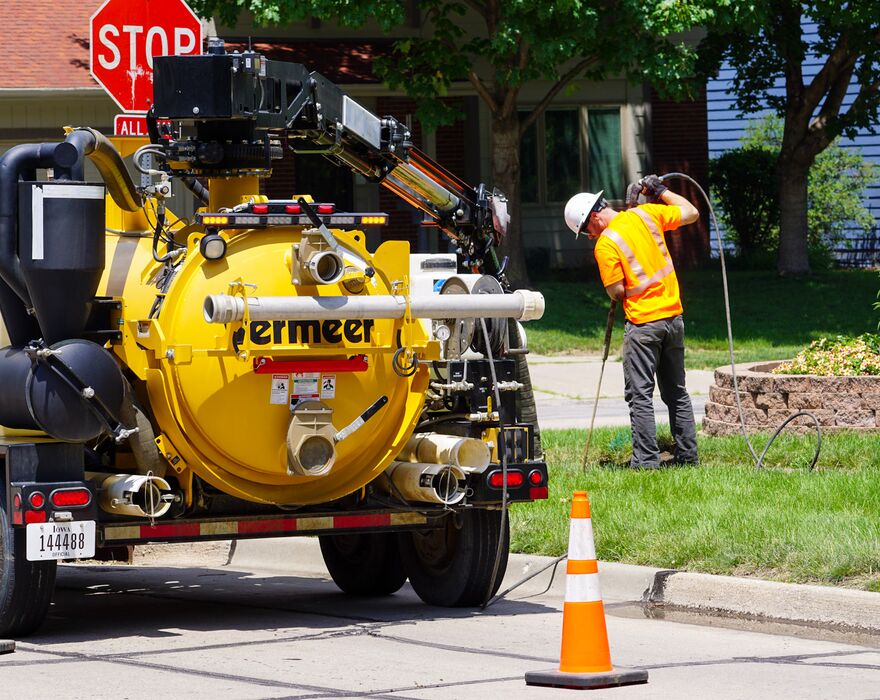
Each verification means a small, careful hole at the curb stop, typically 1 ft x 1 ft (.3 m x .3 m) and 5 ft to 10 ft (1.5 m to 3 m) deep, exposing the line so both the utility and customer side can be inspected at once. That kind of precision excavation is exactly what a vacuum excavator is built for.
The UWU team uses a Vermeer VX50 vacuum excavator, a trailer vacuum excavator outfitted with an extendable boom, safety lights and a hydraulic hitch. With one operator running the dig hose at the curb stop and a second crew member backfilling immediately behind, the team has been averaging about 15 lead service line verifications a day and turned out 115 in a three-week stretch. The extendable boom does much of the heavy lifting, taking real wear off the crew’s shoulders.
The first DNR submittal went in with approximately 1,000 service lines still requiring verification. Through hundreds of verifications since, the team has not found a single lead service line.
A trailer vacuum excavator that earns its keep beyond LCRI compliance
The lead service line inventory work was the catalyst, but the trailer vac quickly earned its place across the rest of the utility’s day-to-day operations. (It’s a pattern playing out at municipalities across the country — see how vacuum excavators are becoming multiuse workhorses in municipal fleets.)
Crews use the VX50 to expose buried valves and replace them without trying to muscle a backhoe into a tight corridor. Crooked or broken valve boxes that used to mean a major backhoe excavation now get swapped out in a fraction of the time. On winter water main breaks at minus 20 degrees Fahrenheit (minus 29 degrees Celsius), the same trailer vac doubles as a water-management tool for water main repair work, pulling standing water out of an active excavation so crews can see surrounding utilities before the backhoe goes to work. On a multiyear sewer relocation project, the VX50 has been the team’s tool for exposing critical water main crossings ahead of contractor work.
Sizing a vacuum excavator for the right-of-way
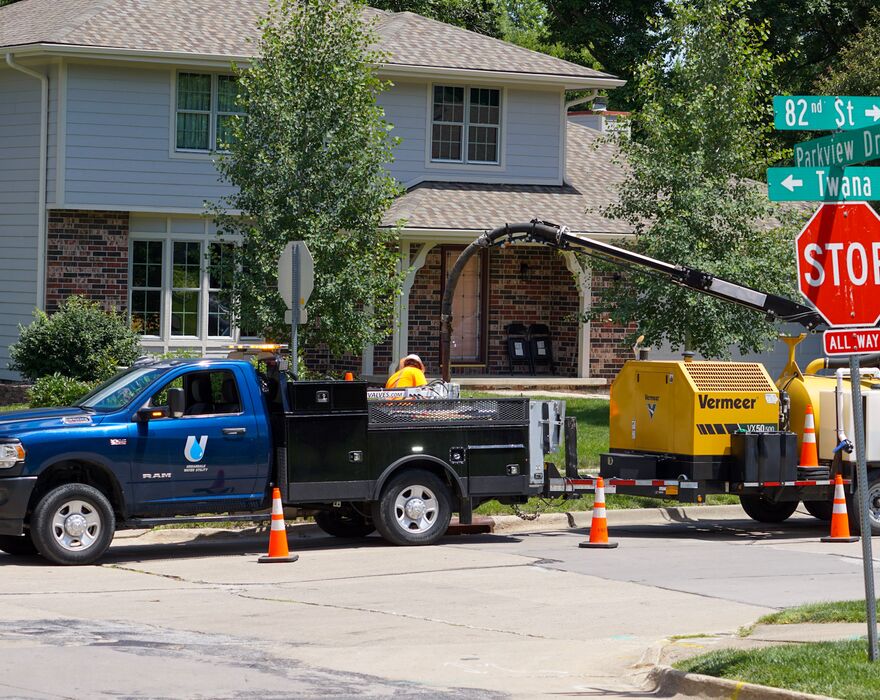
When the city set out to add a vacuum excavator to its fleet, the size of the machine mattered as much as the brand. UWU’s crews work in tight residential right-of-ways every week, and a unit they could haul behind their existing service trucks was non-negotiable.
“It was basically for us to be able to haul around with our trucks and be a little bit more mobile,” said Doug Jacobs, distribution supervisor for UWU. “Of course we’d like to have a bigger one with a bigger spoil tank, but for what we need to get into the places we need to go, that’s just not a good fit for us.”
The team narrowed its options to a few trailer vacuum excavators from different manufacturers, ran demos and settled on the VX50. UWU has worked with Vermeer Iowa & N. Missouri since the purchase. The dealership stays close to the crew, checks in regularly and moves quickly when something is needed in the field.
Contact your local Vermeer dealership for more information about adding a VX50 vacuum excavator to your operation.
This article contains third-party observations, advice or experiences that do not necessarily reflect the opinions of Vermeer Corporation, its affiliates or its dealers. Testimonials and/or endorsements by contractors in specific circumstances may not be representative of normal circumstances experienced by all customers.
Vermeer MV Solutions, Inc. reserves the right to make changes in engineering, design and specifications; add improvements, or discontinue manufacturing at any time without notice or obligation. Equipment shown is for illustrative purposes only and may display optional accessories or components specific to their global region. Please contact your local Vermeer dealer for more information on machine specifications. Vermeer and the Vermeer logo are trademarks of Vermeer Manufacturing Company in the U.S. and/or other countries. © 2026 Vermeer MV Solutions, Inc. All Rights Reserved.