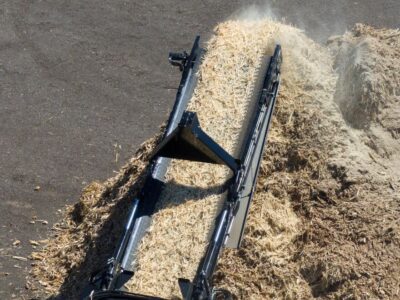
When a horizontal grinder is central to your operation, knowing how productive it is shouldn’t be a mystery. But for many crews, it still comes down to estimates. The Vermeer productivity monitoring system is designed to replace guesswork with real-time data, helping you understand how your machine is performing as the work happens.
That shift was intentional.
“We want to provide tools to our customers to better understand their business, to be more effective and efficient,” said Jeff Bradley, Vermeer product manager.
Instead of relying on end-of-day numbers, operators and owners can monitor performance in real time and adjust accordingly — turning productivity into something measurable, not assumed.
What is the Vermeer productivity monitoring system?
The Vermeer productivity monitoring system is an integrated tool that tracks material volume and fuel usage to show real-time efficiency on Vermeer HG4000 and HG4000TX horizontal grinders. It also connects data from the machine to operators and to owners off-site through the VermeerOne™ platform. This helps teams understand production, fuel usage and performance across jobs.
Operators can control the horizontal grinder and adjust on the fly, while owners get insight into where money is made — or lost.
What can the Vermeer productivity monitoring system help you do?
- See efficiency as you run — using production volume compared to fuel usage
- Make setting changes and immediately see the impact on performance
- Log production by job for clearer billing and job review
- Set a target volume and automatically stop grinding at the set point
- Keep the jobsite and office aligned through the VermeerOne™ platform
Track fuel efficiency with production-per-gallon data
According to the U.S. Department of Agriculture Forest Service, fuel consumption plays a major role in forestry operations. The challenge has been understanding what that fuel is actually producing.
That’s why the productivity monitoring system tracks your production per gallon or liter. A Vermeer-patented lidar-based measurement system tracks the cubic yards or cubic meters processed compared to the fuel usage.
That data is delivered in real time, giving operators a clear view of overall efficiency — not just total output.
As Bradley put it, the goal of a grinder operation is simple: “Getting the most off the end of the belt for the least amount of fuel.”
With insights from the Vermeer productivity monitoring system, operators can actively adjust settings like feed rate and down pressure to improve performance. Making changes and seeing the impact in real time allow crews to fine-tune their horizontal grinder to best process the material at hand — whether it’s logs, organic materials or green waste.
Instead of waiting to adjust at the end of each day, your crew is making informed decisions in the moment — helping reduce wasted fuel and protect your margins.
Productivity monitoring connects wood waste jobsites and their back offices with VermeerOne
The Vermeer productivity monitoring system keeps everyone aligned, from operators at the machine to decision-makers in the office.
Onboard displays provide immediate feedback, so operators can see how their horizontal grinder is performing and adjust on the fly. At the same time, the VermeerOne™ platform connects that same data to the back office, giving visibility across jobsites, machines and operators.
And that visibility doesn’t stop at just one job.
“A powerful aspect of our productivity monitoring tool is you can record and store over time the machine’s productivity and fuel consumption and really cross correlate that with different applications or operators,” said Ted Dirkx, Vermeer sales manager.
That shared access to real-time data does more than inform — it helps drive better performance across the team. For operations running multiple grinders, this visibility becomes even more valuable, especially when performance varies.
“It may point out areas where you can help train operators to be more efficient,” Bradley said.
The result is a more connected operation where everyone is working from the same data — not assumptions.
How real-time data improves horizontal grinder bids and billing
Across the industry, productivity has often been built on best guesses. That uncertainty forces contractors to build in buffer, at times costing their competitive edge.
“The current standard in the industry is a lot of guesstimating,” Dirkx said. “Contractors have to give themselves a little bit of buffer, so they don’t underestimate what their actual costs are to produce a given yard of material.”
The Vermeer productivity monitoring system replaces that guesswork with actual jobsite data. By tracking production by job and tying it directly to fuel usage, operators gain a clearer understanding of the true cost for each horizontal grinder to run.
That measurable insight changes how bids are built. Instead of estimating or padding numbers, crews can base decisions on real operating data.
“It really helps provide a much more accurate measuring stick so they can tighten their margins and be more competitive and know more concretely what their efficiency is,” Dirkx said.
Track production by jobsite for accurate billing
Production can be logged by job, allowing you to track how much material was processed for a specific customer or location. This creates a clear record and opens the door to billing by volume, time or output, not estimates.
Control output with the target set point feature
On the production side, the system’s target set point feature gives operators more control over output. You can set a defined production volume and have the grinder automatically disengage once that target is reached. This helps prevent overproduction and keeps material output aligned with demand — especially when producing finished material.
Pair with the Vermeer coloring system for finished output control
For mulch producers, that control becomes even more valuable. When paired with the Vermeer coloring system, operators can produce targeted volumes of finished, colored material with greater confidence — helping improve inventory management and reduce wasted effort across batches.
Vermeer-built and integrated — not an extra device to manage
The Vermeer productivity monitoring system isn’t a separate add-on system — it’s built directly into the machine. That means no extra devices, no separate data plans and access is included for the first three years — so you can focus on the work, not the tech.
That integration is what makes the data more usable and more accurate.
With a fully integrated system, the production data is recorded in a shared location. There is no manual tracking and no need to piece together information from multiple sources.
The integration simplifies daily operation. The system moves with the horizontal grinder, folding with the machine for transport without requiring disassembly or extra setup.
And because the system is designed to be user-friendly, operators can get up to speed quickly.
“If you can run a smartphone, you can run this,” Bradley said.
Get a better handle on your productivity
The difference between guessing and knowing adds up fast when operating horizontal grinders. The Vermeer productivity monitoring system gives you the data to understand performance, control output and make smarter decisions across your operation.
Here’s what that looks like on the job:
- See real-time efficiency, not end-of-day estimates
- Adjust machine settings and immediately see the impact
- Track production and fuel usage in one place
- Bid jobs with more accurate cost data
- Reduce overproduction and better match output to demand
If you want a better handle on the productivity of your operation, reach out to your local Vermeer dealer to learn more.
Vermeer Corporation reserves the right to make changes in engineering, design and specifications; add improvements; or discontinue manufacturing at any time without notice or obligation. Equipment shown is for illustrative purposes only and may display optional accessories or components specific to their global region. Please contact your local Vermeer dealer for more information on machine specifications. Vermeer, the Vermeer logo, Equipped to Do More, and VermeerOne are trademarks of Vermeer Manufacturing Company in the U.S. and/or other countries.
© 2026 Vermeer Corporation. All Rights Reserved.