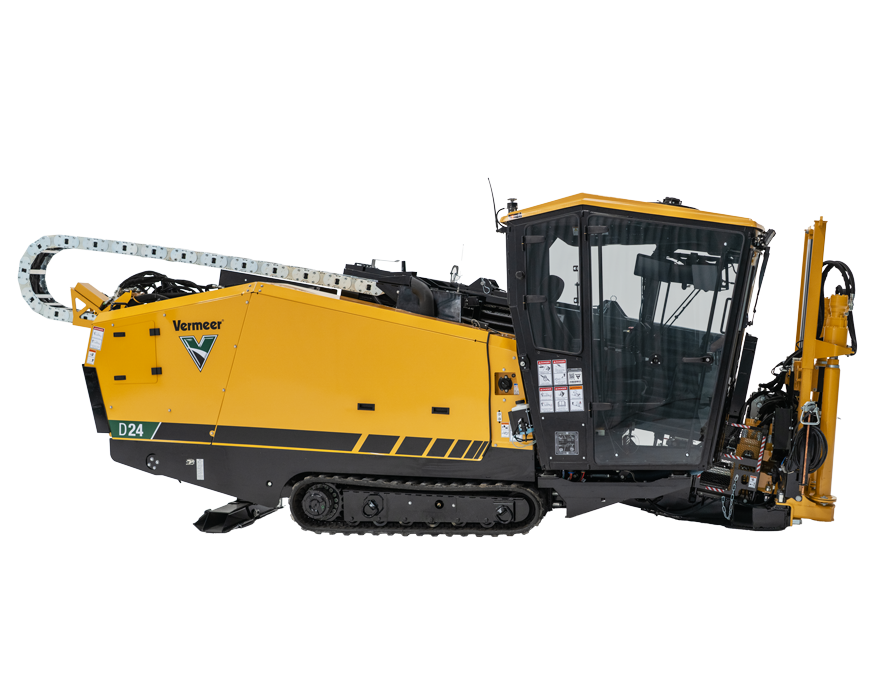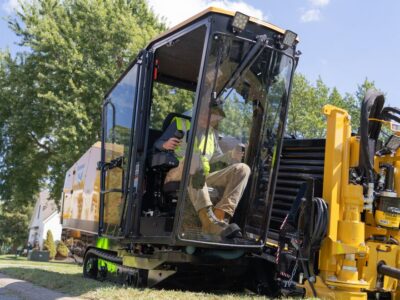
At Utility Expo, a hulking operator stepped into the new cab on the D24 horizontal directional drill, settled into the seat, adjusted the screen and closed the door. He twisted his shoulders and maneuvered inside the drill cab, testing its comfort.
Kevin Burgoni stood nearby, quietly watching the man interact with the cab. He helped design it as part of the Vermeer industrial design team.
“He looked over at his buddy and just started talking,” Burgoni said, describing how the man settled into the cab as if he were already on a job site — settled in and comfy. “That was pretty validating.”
Burgoni’s anticipation gave way to pride. The cab felt natural — exactly the point.
That kind of ease didn’t happen by accident. It began as a wooden buck in Ames, Iowa — foam trimmed, taped and tested — long before any steel was cut.
The Vermeer D24 is the only drill in the 24,000‑pound (110‑kN) class to offer a factory‑installed cab — a comfort package engineered into the machine from the start, with heating, air conditioning and a wireless radio, plus an operator ear rating near 73 dB(A).
The aim was straightforward: keep crews in the seat and on the job year‑round, turning operator comfort into productivity. Vermeer got there by listening to customers, solving tight packaging — including a sliding vise and constrained envelopes — and making deliberate design choices around ergonomics, sightlines and heat management.
That operator Burgoni watched wasn’t alone. At the Utility Expo in Louisville in October 2025, the cab drew steady crowds and quick praise.
“People were freaking out about it,” Burgoni said.
The project to add a cab on a drill this size stretched back years. It began with in‑depth voice of customer (VOC) work that informed the industrial design team and Vermeer engineers on how to create solutions customers asked for.
By the time the D24 reached Louisville, the cab reflected dozens of customer interviews and hundreds of deliberate choices about width, glass, controls and operator fit.
This is the story of that design.
How D24 directional drill cab design began with ‘voice of customer’
To create the cab, Vermeer started where its drills live — on job sites.
“For me, the product development process starts with what we call ‘voice of customer,’” product manager Clint Recker said. “That usually is years prior to the product going into production.”
He and the team sampled “dozens and dozens and dozens of customers,” gathering what operators liked, what they didn’t and what they needed to work year‑round.
“When we do the voice of customer process, it’s always through a dealer — the trusted person that customer works with,” Recker said.
Those conversations had a clear theme: comfort and control in the elements. Northern crews asked for relief from winter; others wanted less heat and glare. “In general, a comfortable operator is more productive,” Recker said. Europe pushed hardest for cabs, and that expectation helped set the bar for North America.
The feedback came from highly regulated regions — the United States, Canada, Europe and Australia. The asks were specific. Operators wanted clear sightlines to the front vise and dependable visibility to the rear joint — which the camera supports — especially with the new sliding vise moving hardware in a tight envelope. Wiper placement and glare‑reducing tint were addressed within the Vermeer safety engineering criteria.
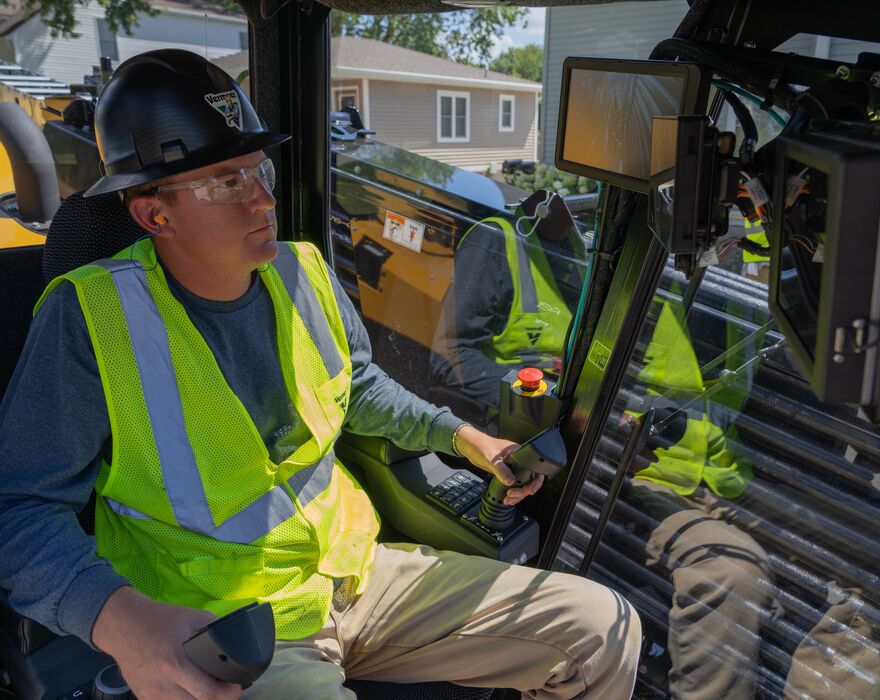
Comfort extended to the seat. Recker noted the move to a high‑back, name‑brand seat with a headrest and greater adjustability — another response to operator feedback. It also meant moving the displays from the D24x40 S3 horizontal directional drill layout to a position that felt natural in the D24 — visible at a glance, without encroaching on the operator’s space.
By the time VOC wrapped, the team had a clear mandate: build a cab into the D24 from the start and design it to feel bigger than it looks, with ergonomics and visibility that keep crews in the seat and on the job.
From wood and foam to a ‘cavernous’ cab on a directional drill
The big early question was cab width. The designers favored a wider cab but knew they’d need to prove it.
“Our opinion was we wanted it to be the larger width, but we knew we’d have to kind of win some people over,” industrial designer Blake Conant said. “So we built that buck first and then used foam to close in the buck to the proposed width that was smaller than that.”
“That way we could put individuals in the cab at that smaller width,” Conant said. Testers tried it and told the team, “OK, I can barely spread my arms.” When the foam was pulled and the original width restored, the reaction flipped: “OK, this is so much better.”
Ergonomics helped inform other decisions.
Vermeer industrial designers scrutinized everyday touchpoints. Using CAD human models, the team lowered the door‑handle height so it felt natural from inside the cab and set displays farther away to keep viewing distance comfortable.
“If that angle stayed the same all the way up to the top, those displays would be like six inches from your face — and it would not be a very good user experience,” Conant said.
Visibility was non‑negotiable — and balanced against heat load. Burgoni called it a “push and pull between giving more visibility and creating more of a greenhouse.”
To lock critical sightlines, the team leaned on simple physical checks while they refined window profiles.
“We did actually cut open a tennis ball and put it on a post and stick it in front of us,” Burgoni said, placing it at the front vise and rear joint to confirm what the operator needed to see.
Supplier collaboration and VR flattened surprises. The team worked with Terra Cab to fine‑tune glass area — where trimming a pane wouldn’t cost visibility but would cut solar gain — and ran inside‑out vision testing in VR to validate sightlines and reach before prototypes.
“Take some glass out here — you won’t lose much visibility, but you’ll gain less of that sun energy,” Burgoni said.
Comfort scaled with the seat and the controls. The cab moved to a high‑back, name‑brand seat with cloth upholstery, a headrest and lumbar support — and controls were set on purpose‑built arm pods to keep key functions at a natural rest position for long hours in the chair.
“With this cab, we’re going with cloth seats,” Burgoni said. “The back is higher, there’s a headrest, there’s lumbar support.”
The cab’s geometry carried the rest. A forward‑lean, tapered‑up profile tied into Vermeer’s design language and made the interior feel larger within a compact footprint.
“It makes the inside feel way more cavernous,” Burgoni said.
“We’ve never put a factory‑installed cab on a machine of this size,” Recker said. “The industrial design team did a fantastic job of making this small cab not feel like a small cab.”
The big challenge? Fitting a factory cab on a compact directional drill
From there, integration became a game of inches — fitting a factory cab around a sliding vise, tight envelopes and real structural loads.
Product engineering started with structure. The platform had to absorb cab mass while protecting maneuverability and service life.
“Now, of course, we’re carrying more weight than the prior generation had intended to carry,” Recker said.
The next generation of directional drills introduced a sliding vise to speed break‑out and preserve sightlines to the rod joint — in the same space the cab needed. That put a moving mechanism where the enclosure wanted to live, forcing the team to map clearances and reroute components to keep the joint visible and the system serviceable.
“We’re putting a cab in the same area,” he said. “That’s been part of the challenge with regards to envelopes.”
Mounting points and stake‑downs were strengthened to handle cab loads and keep the drill planted under load.
Because the D24 is a compact utility directional drill, engineers also packaged rear‑rack visibility support so operators could maintain sightlines without trading cab placement.
Crucially, the D24 wasn’t retrofitted — it was built to carry a cab.
“This machine was designed from the start to have a cab,” Recker said. “From a structures standpoint, we feel very confident in that structural integration.”
Design hits the mark: D24 cab interest ‘greater than we had anticipated’
Early planning assumed a modest cab take rate, with Europe driving most of the demand. After Louisville, that outlook changed.
“The interest was much greater than we had anticipated,” Recker said.
Utility Expo helped clarify where that demand was coming from.
“Utility Expo is an international show, but the majority of the people are from North America,” Recker said.
For customers, the benefits were practical. A factory‑installed cab kept crews on the job in heat or cold, reduced exposure to the elements, lowered noise at the operator ear and supported clear sightlines to critical operations — comfort tied directly to productivity.
In Louisville, the response to the cab was visible from where Burgoni stood.
“Every time I would look over there, it was just 100 people,” he said.
Near the front of that line was the same operator Burgoni had watched — moments before he stepped inside the cab, settled into the seat, adjusted the screen, looked over at his buddy and made himself comfortable.
This article contains third-party observations, advice or experiences that do not necessarily reflect the opinions of Vermeer Corporation, its affiliates or its dealers. Testimonials and/or endorsements by contractors in specific circumstances may not be representative of normal circumstances experienced by all customers.
Vermeer Corporation reserves the right to make changes in engineering, design and specifications; add improvements; or discontinue manufacturing at any time without notice or obligation. Equipment shown is for illustrative purposes only and may display optional accessories or components specific to their global region. Please contact your local Vermeer dealer for more information on machine specifications. Vermeer and the Vermeer logo are trademarks of Vermeer Manufacturing Company in the U.S. and/or other countries.
©2026 Vermeer Corporation. All Rights Reserved.