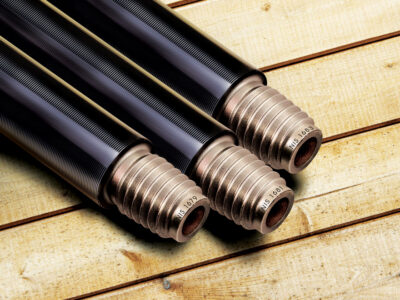
Horizontal directional drill (HDD) contractors feeling completely confident in their drill rod is a must during demanding fiber, gas and water installation work.
When compared to the industry standard, Vermeer Firestick® drill rod stands alone.
Invented to set a new standard for performance and longevity, Firestick drill rod has become the preferred choice for high-difficulty bores, applications requiring precise steering and operations where maximizing the lifecycle of a rod is a priority.
Not all drill rod is built the same, and drill-rod decisions should be based on more than initial cost.
Metal fatigue, cyclic bending and stress induced by torque, thrust or pullback place high demands on your drill rod. Steel grade, thread profile design, steerability, traceability and product support are factors that differentiate drill rod in the field.
Knowing the demands of your work and your drill rod options can help you select the ideal choice to complete the bore with confidence.
On paper, many rods may look similar. Underground, differences make or break projects. Choosing the right drill rod impacts steering accuracy, connection reliability under load, and how much you are spending to replace drill rod that doesn’t hold up.
So what makes Firestick drill rod different? It starts with the way it is engineered, built and supported. Let’s examine how.
How Firestick drill rod differs in steel, construction and threading
Most drill rod in the HDD market is made from S135, a standard steel alloy rated at 135,000 lb (61,235 kg) of tensile strength.
Firestick drill rod is exclusively built from V145, a codified version of S135 rated at 145,000 lb (65,770kg) of tensile strength.
That difference isn’t just a number.
The additional chemical properties in the heat-treated, high-carbon alloy steel give V145 an extra edge in flexibility without sacrificing toughness, which is critical when a rod string is bending and recovering thousands of times across a long bore.
The structural design of Firestick drill rod compounds the strength advantage, earning its reputation in the industry for an ability to stand up to high-torque applications while maintaining a large inside diameter to maximize drilling fluid flow.
Many aftermarket drill pipe options use a three-piece welded construction, where the tube body is inertia-welded to the tool joint at each end. Those welds introduce a potential failure point — one that becomes more pronounced under the fatigue of tough drilling conditions. Firestick drill rod is one-piece forged, creating a smooth upset that handles the load more efficiently and eliminates the weld-related failure risk altogether.
The thread profile of the Firestick drill rod makes the rod strength even stronger. Developed through a collaboration among Vermeer engineers, metallurgists and industry threading experts, the Firestick thread is coarse and tapered for fast, reliable makeup in the field. When brought to full torque, the internal and external shoulders mate simultaneously with the load flank on the threads — a timing that is unique to Firestick drill rod and produces a consistently strong connection bore after bore.
Every piece of Firestick drill rod starts with U.S. or German steel and is quality inspected throughout the tube-forming process. Forged ends are 100% inspected, validated through heat treatment and then put through a 100% thread inspection process — on every piece.
Finally, each Firestick drill rod carries a batch number for traceability. In an industry where rod failure or performance issues can be difficult to diagnose after the fact, that traceability means your dealer and Vermeer have the information needed to understand what happened.
How Firestick drill rod compares to standard drill rod
Much of the drill rod sold to the HDD market is manufactured to S135 grade steel — a solid, proven standard that handles demanding bore conditions in straightforward applications at moderate difficulty. For plenty of jobs, S135 works.
But with Vermeer Firestick drill rod, the difference shows over time and under pressure.
Compared to the Firestick drill rod’s V145 steel, S135 rod can reach wear and fatigue thresholds sooner, meaning more frequent replacement in high-volume operations. Thread designs across standard rod vary by manufacturer, and inconsistent makeup — whether from thread geometry or manufacturing variability — introduces risk in long bores where connection integrity matters most.
Standard rod also typically lacks the batch traceability that Firestick drill rod provides. For contractors who want to understand performance trends across their rod inventory, that gap in data can become a real operational problem.
As Firestick drill rod continues to grow in popularity, other suppliers claim to have compatible drill rod, leading to potential confusion. The best way to make sure that you are buying Vermeer Firestick drill rod is to locate the NIS number at the end of the thread.
Why drill rod total cost of ownership matters
Upfront rod price is a real number that shows up on a purchase order. Total cost of ownership is the number that shows up in your margin at the end of a project.
For contractors running consistent volumes in challenging conditions — fiber deployments through rocky or congested ground, water and sewer work with complex bore paths or any application where re-drilling a failed bore is extremely costly — the math on premium rod can make sense. Fewer rod replacements, more consistent steering, and less downtime from connection-related issues may offset the higher per-rod price over the long run.
For occasional, lower difficulty work where bore paths are straightforward and ground conditions are forgiving, standard rod may be an acceptable choice. The key is making that decision with a clear picture of what you’re comparing instead of treating all rod as interchangeable and defaulting to the lowest price.
How to choose the right drill rod for your work
A few questions worth working through before your next rod purchase:
- How difficult are your typical bores — soil conditions, depth, length, bore path complexity?
- How critical is steering precision on the jobs you’re bidding?
- What does a rod failure or bore re-drill cost you in time and rework?
- Are you tracking rod performance over time — and do you have the traceability data to do it?
If your answers point toward challenging conditions, precision requirements, and a focus on long-term operational efficiency, Firestick drill rod is specifically built for that work.
The Vermeer drill rod selection guide walks through the key considerations — and your local Vermeer dealer can help you match the right rod to your bore conditions.
View Firestick drill rods at borestore.com.
Vermeer Corporation reserves the right to make changes in engineering, design and specifications; add improvements; or discontinue manufacturing at any time without notice or obligation. Equipment shown is for illustrative purposes only and may display optional accessories or components specific to their global region. Please contact your local Vermeer dealer for more information on machine specifications.
Vermeer, the Vermeer logo, Equipped to Do More, Firestick and Borestore are trademarks of Vermeer Manufacturing Company in the U.S. and/or other countries. © 2026 Vermeer Corporation. All Rights Reserved.