The best utility directional drill is the one that fits your work before the bore even starts.
It fits the length of your average install. It fits the ground you drill through most often. It fits the streets, yards and rights-of-way where your crews spend their days. And it fits the way you move equipment from one job to the next.
That is why choosing a Vermeer utility directional drill starts with the job, not just the spec sheet. This guide walks through the most common types of utility work and shows which Vermeer horizontal directional drills make the most sense for each.
Underground utility work is being shaped by several major infrastructure needs at once, from the Broadband Equity, Access and Deployment (BEAD) program to 20-year drinking water infrastructure needs and broader efforts showing how undergrounding can help improve reliability.
If you are trying to narrow the field, start by matching your horizontal directional drill to the kind of utility work you do most often.
Tight spaces and short installs
Best fit if: Most of your work involves backyard fiber, short service lines or other installs where access is tight and maneuverability matters.
When access shrinks, footprint starts to matter as much as pullback. This category fits crews working in yards, tight residential corridors and other jobs where a compact utility directional drill can get in and drill cleanly.
Utility directional drills to consider from Vermeer
- D8x12 HDD: The D8x12 fits tight-access utility work. It is well suited for backyard fiber work and jobs where a compact footprint is a major advantage.
- D10x15 S3 HDD: The D10x15 S3 fits small service line work and other short installs where access still limits the drill choice, but the job calls for a step up from the smallest class.
If the job is short, the site is tight and the goal is clean entry and exit, start here.
Everyday city utility work
Best fit if: You regularly install fiber, gas or power in congested urban areas with streets, sidewalks and existing underground infrastructure.
This is the core of a lot of utility work. Streets stay busy. Rights-of-way stay crowded. Existing lines compress your options. In these settings, horizontal directional drilling earns its keep because trenching can disrupt traffic, pavement and nearby businesses.
That logic also appears in Federal Highway Administration guidance on trenchless methods, which points to trenchless construction as a way to reduce pavement cuts and surface disruption while warning that soil, rock and uncertain utility locations still shape whether it is the right method for the job.
Utility directional drills to consider from Vermeer
- D20x22 S3 HDD: The D20x22 S3 fits everyday gas and fiber work in congested urban areas. It is a strong option for crews that need a dependable, everyday utility directional drill with enough power for a range of routine installs. with enough power for a range of routine installs.
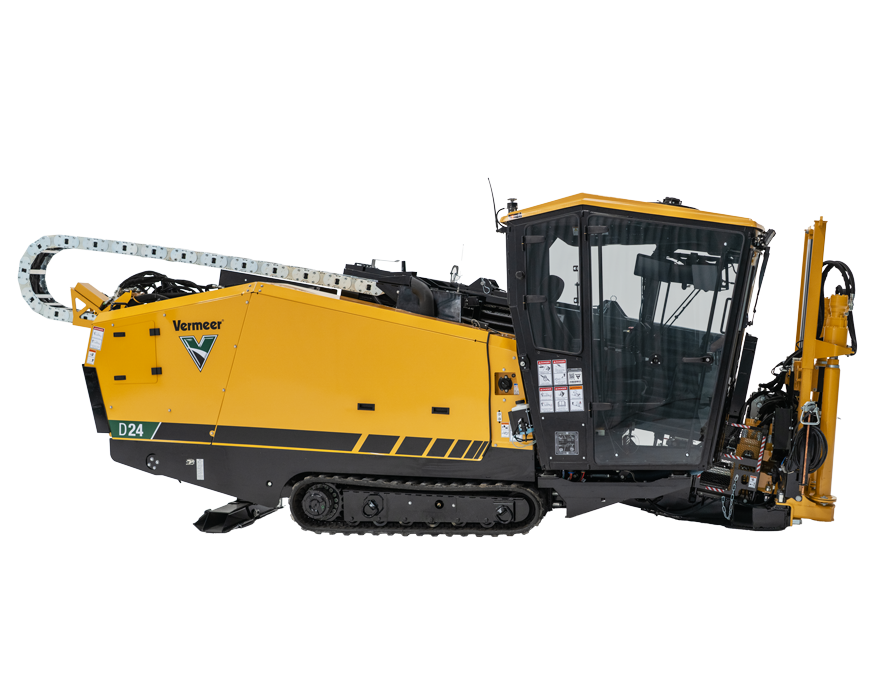
- D24 HDD: The D24 fits contractors who want next-generation features in a utility directional drill built for precise drilling and efficient operation in crowded city environments.
- D24S HDD: Built for select international markets, the D24S is positioned for urban fiber work in congested streets, where compact size and operator comfort both matter.
- D24x40 S3 HDD: This versatile machine fits crews that need a drill with a compact enough footprint for city utility work and the power to pull larger product when the job demands more. With 28,000 lb (124.6 kN) of thrust/pullback and 4,200 ft-lb (5,694.4 Nm) of rotational torque, it gives crews more capability when the job demands it.
If your day-to-day work lives in city streets and tight rights-of-way, this is where the shortlist starts to take shape.
Rock and difficult ground
Best fit if: Rock, hard clay or mixed formations drive the decision more than access alone.
Some jobs are defined by the street. Others are defined by the ground. If your bore path runs through hard clay, rock or changing formations, drill choice has to respond to that reality.
Public trenchless guidance backs that up. FHWA trenchless guidance notes that soil and rock conditions can rule out trenchless methods in some cases, and public HDD planning guidance points to detailed subsurface investigation along the proposed alignment as part of sound project planning.
Utility directional drills to consider from Vermeer
- D23x30DR S3 HDD: The D23x30DR S3 fits rock and mixed ground conditions. It makes sense when the work includes hard clay, rock or other challenging formations that demand more from the drill.
- D40x55DR S3 HDD: The D40x55DR S3 is the step up when utility work grows in scale but difficult ground stays central to the job.
When the bore gets tougher, the drill choice has to get sharper.
A wider mix of utility work
Best fit if: Your crew handles a broader range of bores, utility types and jobsite conditions, and you need a utility directional drill that can cover more kinds of work.
Not every contractor lives in one lane. Some crews move from urban fiber to gas service work to larger mixed installs. In that case, the question is not just what drill fits one job. The question is what drill holds its value across more of your schedule.
That is why average bore specs, jobsite conditions and haul setup matter. Those are the filters that tell you whether you need a niche machine or a broader-use utility directional drill.
Utility directional drills to consider from Vermeer
- D24x40 S3 HDD: The D24x40 S3 fits mixed work. If your crew takes on a wider range of jobs and needs one drill that can cover more ground, this is one of the clearest options to evaluate.
- D24 HDD: The D24 belongs in this conversation if your work stays utility-focused but you want next-generation features in the package.
- D20x22 S3 HDD: The D20x22 S3 also fits when the job mix still leans heavily toward urban gas and fiber installs and you need an everyday workhorse instead of a narrow specialist.
If you need range, not just fit, this category deserves a longer look.
Longer bores and bigger utility installs
Best fit if: Your work is moving into longer bores, larger product or crossings under roads, rivers and other obstacles.
When utility work gets bigger, drill choice gets more important. Longer bores demand more planning. Larger product puts more load on the machine. Road, river and other obstacle crossings can add complexity to the job.
That is where jobsite preparation starts to matter as much as drill size. A solid bore plan helps crews think through terrain, existing utilities, depth, pitch, drill pipe limits and rig setup before the first rod goes in the ground.
Utility directional drills to consider from Vermeer
- D40x55 S3 HDD: The D40x55 S3 fits contractors moving beyond compact urban installs into longer, larger utility jobs where productivity demands rise with bore length and product size.
- D60S HDD: For select international markets, the D60S is positioned as the next step for larger bores and higher-output utility work.
- D60x90 S3 HDD: The D60x90 S3 is built for crews taking on bigger utility work and small pipeline crossover jobs. It gives crews the added force and torque needed when bores get longer, product gets larger and the job calls for more machine. With up to 60,000 lb (266.9 kN) of thrust/pullback and 9,250 ft-lb (12,202.4 Nm) of rotational torque, it is a strong fit when compact utility work starts to scale up.
When the work gets bigger, the drill has to step up with it.
Not sure where your utility installation work fits?
Start with three questions:
- What are your average bore specifications?
- What jobsite conditions do you face above and below ground?
- What are you using to haul the machine?
Before those answers turn into a job plan, locating and verification still matter. Crews should contact 811 before digging and follow local-specific utility notification requirements before excavation or drilling begins. Recent Common Ground Alliance DIRT data shows utility work continues to account for a disproportionate share of excavation damages, especially in water/sewer and telecom work. That is a reminder that locating, potholing and utility verification still shape jobsite performance before the bore even starts.
Those questions help narrow the field fast. They tell you whether you need a compact utility directional drill for tight access, a broader horizontal directional drill for mixed work or a larger machine for longer bores and bigger installs.
What should you look at before you decide?
Match the drill to the work you do most often — not the biggest job you might take once in a while.
Talk with your local Vermeer dealer to compare models, pressure-test the fit against your typical utility work and find the right horizontal directional drill for your operation.
Vermeer Corporation and Vermeer Tianjin Manufacturing Co., Ltd. reserve the right to make changes in engineering, design and specifications; add improvements; or discontinue manufacturing at any time without notice or obligation. Equipment shown is for illustrative purposes only and may display optional accessories or components specific to their global region. Please contact your local Vermeer dealer for more information on machine specifications. Vermeer, the Vermeer logo and Equipped to Do More are trademarks of Vermeer Manufacturing Company in the U.S. and/or other countries.
© 2026 Vermeer Corporation. All Rights Reserved.