Underground easements and roadways are more congested than ever. Gas, water, sewer, fiber and electric lines often share the same right-of-way, and before any digging starts, a call must be placed to 811 so existing utilities can be marked. Those locate marks identify the approximate location of a buried line. Confirming its exact position and depth before excavating near it is the job of potholing, and it has become standard practice on utility and directional drilling jobs across North America.
“Locate marks give a crew the approximate location of a buried utility,” said T.J. Steele, product manager for Vermeer MV Solutions®.” Potholing visually confirms the exact position and depth of the line, and that verification helps crews plan a bore path or trench line with confidence.”
Potholing, daylighting, keyholing and soft digging: what the terms mean
Depending on the region and the crew, this work goes by several names, and the terms are often used interchangeably. Soft digging is the broad category — any excavation method that loosens soil with high-pressure water or compressed air rather than a mechanical blade or bucket. Potholing, daylighting and keyholing describe the task itself. Daylighting refers to digging until the utility is visible or sees daylight. Keyholing describes the small, precise hole the method leaves behind. Whatever a crew calls it, the goal is the same: visually verify a buried line before production digging begins near it.
How vacuum excavation supports potholing
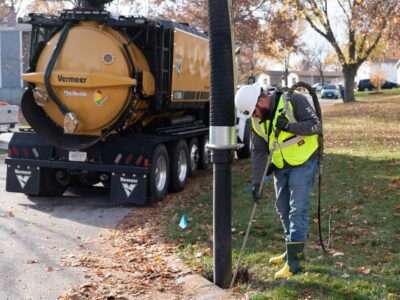
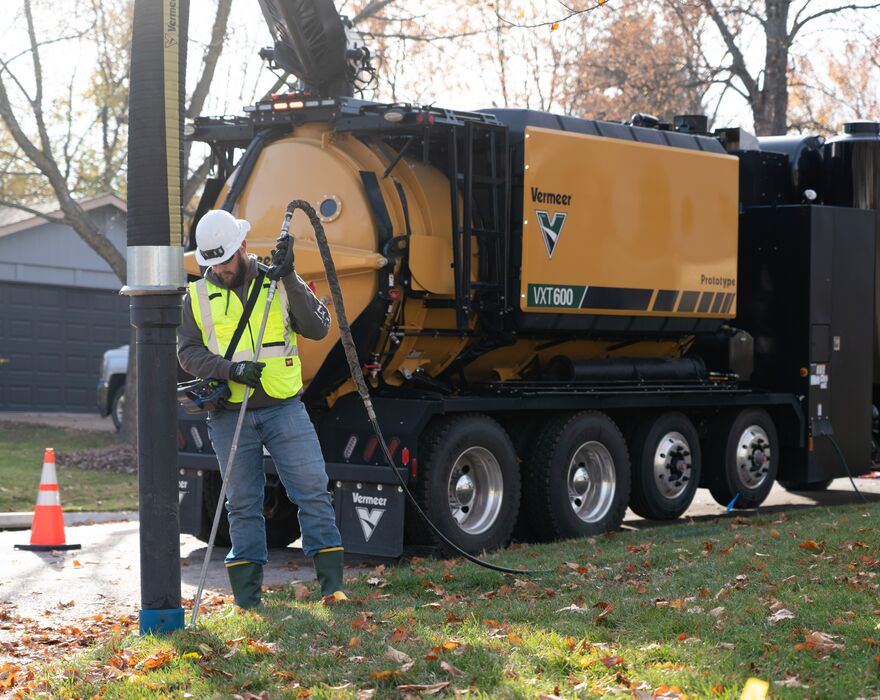
Vacuum excavation is the most common way to do this work. High-pressure water or compressed air breaks up the soil, the unit’s vacuum lifts the loosened material to an onboard spoil tank and the utility is exposed without excavation teeth ever contacting the line.
There is a second benefit beyond utility protection. A typical pothole measures about 1 ft by 1 ft (0.3 m by 0.3 m), so site restoration is minimal compared to digging with a bucket. Reduced restoration time is one of the reasons vacuum excavator usage continues to rise across utility work.
Potholing is especially important on horizontal directional drilling jobs. On almost every utility installation, the contractor must expose the buried lines a new bore will cross to help verify clearance before the drill head reaches them.
Hydrovac potholing or air excavation?
Both methods are forms of soft digging, and both can expose a line without damaging it. Choosing between them usually comes down to ground conditions and spoil handling.
Water cuts compacted soil and heavy clay more efficiently than air, which is why many crews that pothole daily choose hydrovac excavation. The trade-off is the spoil: wet material is heavier to haul and must be disposed of offsite, and the onboard water supply limits run time between refills. Air excavation produces dry spoil that can often be returned to the hole as backfill, which can save time on jobs where restoration drives the schedule, though air is generally slower in hard, compacted ground. Vermeer vacuum excavators are water units as standard, and some models offer an optional onboard air compressor for air excavation and powering pneumatic tools — the Vermeer VX75 vacuum excavator with air includes a 180-cfm, 110-psi (5.1-m³/min, 7.58-bar) compressor — so contractors can spec a unit for the work their crews handle most.
Choosing the right vacuum excavator for potholing
Tank size tends to get the most attention, but three other specifications have a bigger impact on potholing performance.
Airflow and hose diameter need to work together. A 3-in (7.6-cm) hose handles most utility potholing spoil. Cobble and wet clay are easier to remove with a 4-in (10.2-cm) hose backed by a larger blower. The key is maintaining enough velocity that spoil stays suspended until it reaches the tank — if material settles in the hose, it can clog the system.
Suction is the third number. The industry standard for potholing and most drill fluid cleanup applications is 15 in Hg (381 mm Hg) — roughly the lift required to pull a column of water 17 ft (5.2 m) into the air. Higher suction can be beneficial when handling heavy fluid or slurry.
“It comes down to the work a crew does most often,” Steele said. “For many utility contractors, a trailer unit they can tow with a truck they already own and maneuver in a tight right-of-way is the right fit, and that matters more than buying the biggest tank available.”
Vermeer offers vacuum excavators in skid, trailer and truck configurations, with spoil tanks from 100 gal (379 L) to 12 yd³ (9.2 m³) and airflow from 580 cfm to 6,400 cfm (16 m³/min to 181 m³/min). For help comparing models, see the complete guide to Vermeer trailer vacuum excavators and the Vermeer vacuum truck FAQs. Utility contractors who need high-output trailer performance often look at the Vermeer VX75 vacuum excavator, which delivers 1,500 cfm (42 m³/min) and offers configurations for potholing, slurry management and combo applications.
Potholing nozzle selection can affect digging performance
On a hydrovac unit, the nozzle does the cutting, and matching it to the water pump is one of the most overlooked ways to improve productivity.
Nozzle size should be based on pump size and pressure. A number 5 nozzle flows about 4.3 gpm (16.3 L/min) at 3,000 psi (20 MPa), while a number 10 flows 8.7 gpm (32.9 L/min) at the same pressure. Pairing a number 5 nozzle with a 10-gpm (37.9-L/min) pump uses only half the available water capacity, so the nozzle becomes the limiting factor in digging performance. A number 10 nozzle uses the pump’s full potential, but operating it all day can contribute to operator fatigue, which is why many crews choose a number 8.
“Matching the nozzle to the water pump is one of the simplest ways to improve digging performance,” Steele said. “The right nozzle uses the machine’s full capacity and helps crews make efficient use of the water onboard.”
Spray pattern matters as much as size. An 18-degree cone of coverage cuts soil effectively while helping keep the stream from concentrating on the utility itself. The Vermeer QuickDig™ nozzle features an 18-degree pattern and, according to manufacturer-provided performance data, is up to 35% more efficient than a traditional rotary nozzle. Nozzle internals also wear over time — anywhere from a few weeks to a few months depending on use and ground conditions — and some jurisdictions require a nonconductive coating when working near certain lines, so plan for replacements.
Finding the right vacuum excavator for the job
Every potholing job comes down to the same goal: confirming exactly where a buried utility sits before production digging begins nearby. Compare potholing performance across the full lineup of skid, trailer and truck units by downloading the Vacuum Excavation Selection Guide.
When you are ready to see one work on your jobsite, contact your local Vermeer dealer to schedule a demo.
Vermeer MV Solutions, Inc. reserves the right to make changes in engineering, design and specifications; add improvements; or discontinue manufacturing at any time without notice or obligation. Equipment shown is for illustrative purposes only and may display optional accessories or components specific to their global region. Please contact your local Vermeer dealer for more information on machine specifications. Vermeer, the Vermeer logo, Vermeer MV Solutions and QuickDig are trademarks of Vermeer Manufacturing Company in the U.S. and/or other countries. © 2026 Vermeer MV Solutions, Inc. All Rights Reserved.