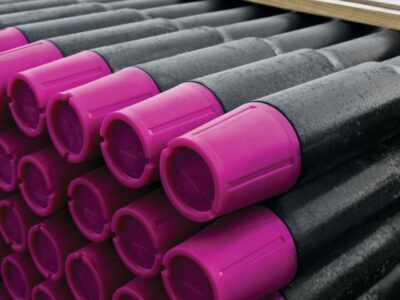
Drill rods takes more abuse than almost anything else on an HDD rig. Every bore puts each rod through bending, torque, thrust and pullback. After enough cycles, rod can start changing in ways that show up before anything fails.
Steering inputs may respond differently. Fluid returns may start to thin out. By the time a rod fails downhole, the warning signs may have been on the rig for a while.
Here are seven signs your drill rod may be working against you — and what you can do to help avoid job-stopping problems.
1. Your drill string does not respond cleanly to steering inputs
Drill rod is designed to flex during a bore and return to straight afterward. When rod loses that ability through routine fatigue or repeated oversteering, the string may not come back straight.
That can make it harder to hold line on fiber installs, utility crossings or other bores where precise steering is imperative.
Watch for:
- Visually bent rod
- Bore drift in ideal or soft soil conditions
- A drill string that does not respond quickly when you steer
- The need to pull back and realign the drill string more often than usual
2. Your threads are galling, seizing or shoulders-mushrooming
Drill rod connections rely on three contact points engaging at full torque at the same time: the pin nose, the shoulder and the thread flank. When threads are not cut precisely, or when those three points do not simultaneously seat together, the joint takes load unevenly.
Damage starts at the tool joint and can compound with every makeup and breakout cycle. Worn or damaged rod joint connections can lead to inconsistent torque transfer, added stress on neighboring joints and a higher risk of downhole issues.
Watch for:
- Visible galling, scoring or shoulder deformation at tool joints
- Connections that are difficult to break out
- Accelerated wear on drill rod threads after mixing rod from different suppliers
- Inconsistent torque readings during makeup
3. You see mushrooming, scarring or fatigue around the tool joints
Every bore puts cyclic bending, torque, thrust and pullback through the drill string. Over time, that stress can show up around the tool joints, especially in demanding ground conditions or on rod that has been through aggressive steering conditions.
Signs of failure often appear first around joints and rod threads. This is why rod construction matters. Inertia-welded drill rod, made from three separate pieces (the mid-body tube and threaded connections), may be more prone to failure under repeated stress than one-piece forged rods.
Watch for:
- Visible scarring or mushrooming near tool joint upsets
- Damage that appears around the same areas on multiple rods
- Wear patterns that show up faster in abrasive or aggressive ground conditions
4. Your rod has been bent beyond its working limits
If rod no longer returns to straight, it can affect how the drill string tracks and responds in the ground. It may also be a sign that the material or construction is not keeping up with the work.
Watch for:
- Rod that curves visibly when rolled on a flat surface
- Steering inconsistency that gets worse as the job continues
5. Your replacement cycles are getting shorter
There is no universal footage or hour mark for replacing drill rod. Ground conditions, operator technique, the rest of the drill string, the subsaver, tooling setup and maintenance practices all affect rod life.
But if your crew is replacing rod more often than usual under similar job conditions, it is worth looking closer. Shorter replacement cycles can be caused by material wear, thread damage, oversteering, abrasive ground or compatibility issues within the drill string.
Watch for:
- Replacement cycles that are getting shorter under similar job conditions
- Visible tube body or upset wear
- Accelerated wear that does not match the ground conditions or application
- Performance or wear issues after mixing drill rod from different manufacturers, even if labeled compatible
6. Your rod purchase price looks good, but the full cost does not
The purchase price of drill rod is easy to see. The full cost shows up later in downtime, abandoned bores, damaged threads, shorter rod life and added rework.
If you are not tracking drill rod performance over time, you may not have the full picture of what your rod is costing the operation.
Ask yourself:
- How difficult are my typical bores? Consider soil conditions, depth, length and steering demands.
- What does a rod failure or abandoned bore cost me in time and rework?
- Am I tracking rod performance over time?
- Do I have rod traceability data to support what happens if a problem occurs?
- Is my consumables spending going up even though job conditions have not changed?
Match your drill rod to the work
If these warning signs sound familiar, the fix starts with the rod you put in the ground. Vermeer Firestick® drill rod is engineered with demanding HDD applications in mind:
Strength and flexibility for demanding bores: Made from a proprietary V145 steel blend rated at 145,000 lb (645 kN) of tensile strength, compared with 135,000 lb (600 kN) for standard S135 rod, with additional chemical properties that help improve flexibility and straight-running consistency.
- Fewer fatigue points downhole: One-piece forged construction eliminates the welds between the tube body and upsets, removing common fatigue points found in three-piece welded rod.
- Reliable connections under high torque: A triple-engagement thread profile allows the nose, shoulder and thread flanks to seat simultaneously at full torque for consistent connection performance in high-torque applications.
- Drilling fluid flow throughout the bore: A large inside diameter helps maximize drilling fluid flow to cool the bit, carry cuttings and support bore stability.
- Confidence in every joint: Every piece receives 100% thread inspection and includes a unique NIS code that traces the rod’s material batch and inspection record.
Aftermarket product marked as “compatible” may not match Vermeer Firestick drill rod thread timing, which can cause galling and shoulder mushrooming over time. Vermeer does not recommend mixing other drill rod with Firestick drill rod.
To confirm you have genuine Firestick drill rod, locate the NIS number at the end of the thread. If it is not there, it is not Firestick drill rod.
For straightforward, less-aggressive projects, Vermeer Silver Series™ drill rod offers one-piece forged, S135 construction threaded in the same U.S. facility as Firestick drill rod, designed for moderate steering applications. Together, the two lines give you trusted options for different project demands — so you can match the rod to the bore instead of using one setup for every job.
Talk to your local Vermeer dealer about matching the right rod to your bore conditions — and whether your current string is carrying its weight.
Vermeer Corporation reserves the right to make changes in engineering, design and specifications; add improvements; or discontinue manufacturing at any time without notice or obligation. Equipment shown is for illustrative purposes only and may display optional accessories or components specific to their global region. Please contact your local Vermeer dealer for more information on machine specifications. Vermeer, the Vermeer logo, Equipped to Do More, Firestick, and Silver Series are trademarks of Vermeer Manufacturing Company in the U.S. and/or other countries.
© 2026 Vermeer Corporation. All Rights Reserved.